
How we can help
How can you transform your garden to look like the Cottesbrooke border?
One family has been shaping the gardens at Cottesbrooke since 1936, with designers such as Arne Maynard. With Garden Design App, you add a photo of your garden, choose the Cottage style with Plum to peach colours, and ask for the Cottesbrooke touches you love: a rose on a dome, dark plum leaves behind pinky apricot foxgloves, icy blue along the edge. In just one minute you see your garden redesigned in a plum, pink and icy blue look inspired by the Cottesbrooke border, with your house, trees and fences kept.
- See the look before you spend. A tonal border is hard to picture from a plant list: too rich and it shouts, too pale and it fizzles away. Try a rose on a dome by the path, then without it, and keep the design you love.
- Plants that will grow for you. With Pro or Max, every plant is named and picked to thrive where you live, in your light and soil, ready to buy, so the foxgloves, roses and asters you saw are the ones you plant.
- Save over £1,900. The average UK garden design costs £1,950, and a designer can take weeks to months to come back with a first design. Garden Design App gives you one in just one minute.
Your first 3 designs are free, with no card needed.
See a real Cottage garden redesignWhat Cottesbrooke Hall gardens are, and who made them
Cottesbrooke Hall is a Queen Anne house of mellow brick in Northamptonshire, looking out over an 18th century park with a lake and grazing sheep. The estate’s website puts its gardens at 13 acres. The Macdonald-Buchanan family bought the hall in 1936, and the estate describes what followed as a continuous programme of change by three generations of keen gardeners. The Garden Visitor · Cottesbrooke Hall
They took over an Arts and Crafts garden laid out by Robert Weir Schultz early in the 20th century: garden rooms wrapped around the west side of the house, divided by formal hedges and warm brick walls, with views punctuated by statues. Beyond them, flanking a small brook on the other side of the park, lies the Wild Garden, with spring bulbs, gunnera, fine acers and specimen trees. Cottesbrooke Hall
Catherine, the present owner’s grandmother, brought in the landscape architect Geoffrey Jellicoe to develop the Forecourt, with its large yew cones, lead statues and blue agapanthus in pots. After the war she worked with Sylvia Crowe on the Pool Garden, made from the walled yard where the hall’s laundry was once hung to dry. Under John, the present owner’s father, the garden won the Christie’s and Historic Houses Association Garden of the Year award. Cottesbrooke Hall
The present owner and his wife Sheran have moved it on again with the designers Arne Maynard and James Alexander Sinclair. A visit report on The Garden Visitor describes Maynard taking the Iceberg roses out of Jellicoe’s 1937 yew parterre and filling it with tall golden moor grass (Molinia caerulea), and calls Cottesbrooke one of England’s greatest contemporary gardens. Cottesbrooke Hall · The Garden Visitor
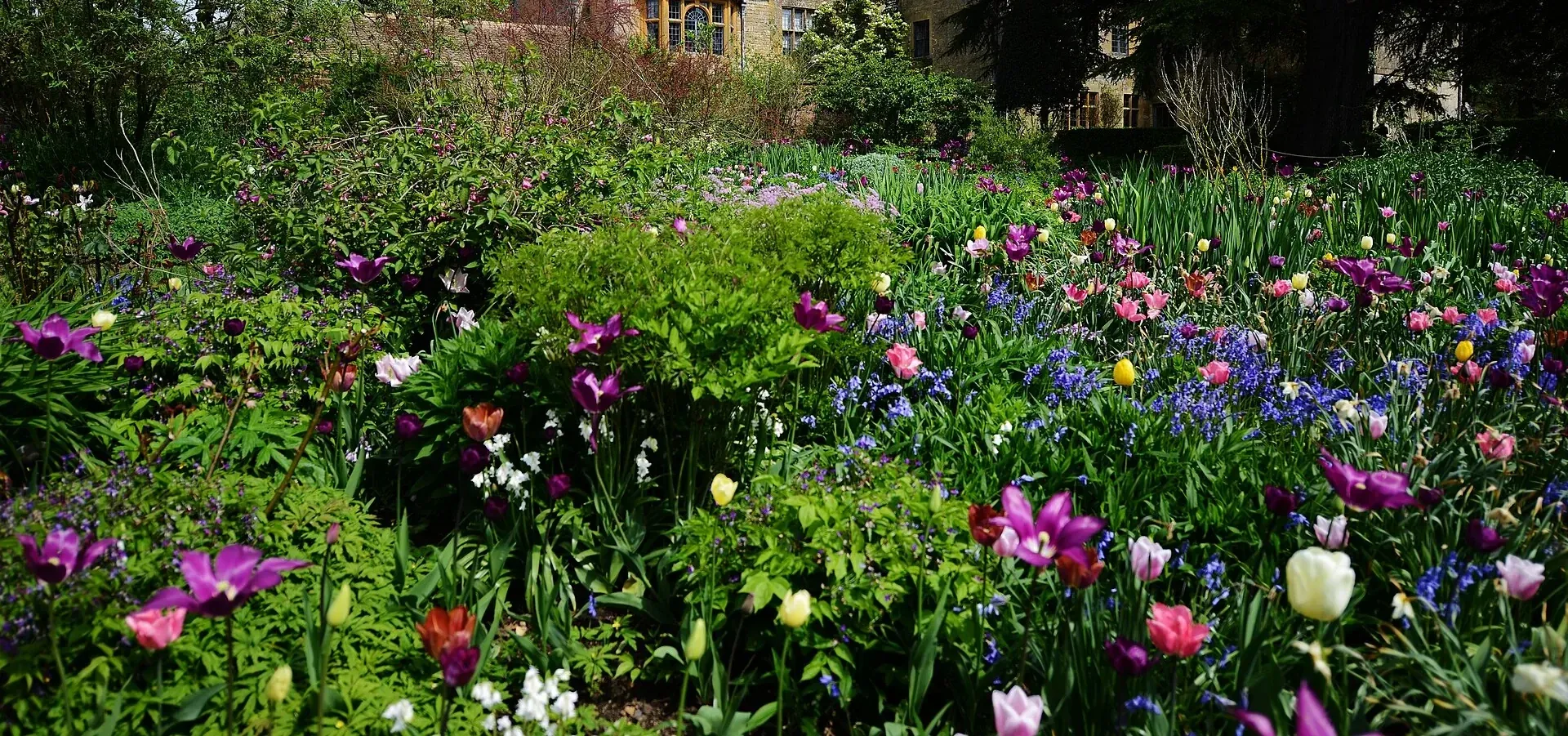
This page is about the Statue Walk border, which Gardens Illustrated credited to Maynard in 2018: pale pinks, deep purples and icy blues. The same visit report found the border leading to the Statue Walk loose and three dimensional rather than tall at the back and short at the front, with deep plum Cercis ‘Forest Pansy’ repeated among purple, lilac and blue perennials such as monarda and phlox. The garden is open to visitors; details are on the Cottesbrooke Hall website. Gardens Illustrated · The Garden Visitor
Why the Cottesbrooke border works: six ideas to borrow
Gardens Illustrated walks through how Maynard made the Statue Walk border, and The Garden Visitor saw it in full summer. These are the ideas worth taking home when planning a pink and purple border of your own. Gardens Illustrated · The Garden Visitor
One pale slice of colour
Gardens Illustrated says Maynard used “a pale slice of the colour wheel”: pinks, purples and icy blues. That is what makes it a tonal border rather than a mixed one. Too rich, the article says, and it would shout over its setting; too pale and it would fizzle away. A pink and purple garden with no yellow, orange or hot red reads as one calm picture. Gardens Illustrated
A dark undercoat
The planting begins with dark plums and rich pinks, which the article says bring life to the paler colours. Plum coloured plants work like the shadow in a painting: ruby astrantias, purple leaves and near black tulips make the soft pinks look brighter. Our dark and dramatic border page goes further with the darkest of these. Gardens Illustrated
Icy blue for light
“Whites and cool blues bring the right amount of luminosity even on a gloomy day,” the article says. A few pale blue flowers keep a pink and purple border from looking heavy under a grey sky. Gardens Illustrated
Repeat, do not collect
The visit report notes the same purple leaved tree repeated along the border, and Gardens Illustrated says repeating the same varieties shapes the mood as much as the colours do. Fewer kinds of plant, used again and again, make a border feel planned. The Garden Visitor · Gardens Illustrated
Domes that divide the space
At Cottesbrooke the climbing rose The Generous Gardener (Rosa The Generous Gardener) is trained on dome shaped frames which, Gardens Illustrated says, have the presence to divide up the space. At his own garden, Allt-y-bela, Maynard shapes hazel from nearby hedgerows into domes to hold roses. Domes give a loose border rhythm without a single clipped hedge. Gardens Illustrated · Allt-y-bela · Gardenista
Loose, not in rows
The visit report found the border loose and three dimensional rather than tall at the back and short at the front, and in June, Gardens Illustrated says, ‘Sutton’s Apricot’ weaves its pinky apricot way through the whole border. Let a few tall foxgloves rise through the middle as well as the back, so the eye moves through the planting. The Garden Visitor · Gardens Illustrated
Plum, pink and icy blue plants through the year
First, the plants that published accounts name in the real Cottesbrooke border. Then the plants we suggest for a pink and purple border at home, season by season. Where we suggest a stand in for the garden’s own plant, we say which.
Cottesbrooke border plant list from published accounts
- Foxglove ‘Sutton’s Apricot’
- Digitalis purpurea ‘Sutton’s Apricot’ weaves its pinky apricot way through the whole border in June. Gardens Illustrated
- Rose The Generous Gardener
- The climbing rose trained on dome shaped frames to divide up the space. Gardens Illustrated
- Astrantia and bellflower
- Masterwort ‘Ruby Wedding’ (Astrantia major ‘Ruby Wedding’) and the violet bellflower ‘Prichard’s Variety’ (Campanula lactiflora ‘Prichard’s Variety’). Gardens Illustrated
- Common valerian
- Valeriana officinalis, which Gardens Illustrated says self seeds freely. Gardens Illustrated
- Cercis ‘Forest Pansy’
- The deep plum tree repeated along the border, among purple, lilac and blue perennials such as monarda and phlox. The Garden Visitor
Gardens Illustrated lists the plants that make up the Cottesbrooke border, and five of them are in our Cottesbrooke look: the foxglove, the rose, the masterwort, the bellflower and the valerian. Its list also names Cercis ‘Forest Pansy’ and Actaea ‘Pink Spike’; in our look a redbud and a persicaria stand in for those two. Everything else is ours, chosen to carry the same colours through the year. Gardens Illustrated · Our planting theme
Plants for a pink and purple border at home
Choose plants that take over as the previous ones fade, and keep to the same band of colour all year: dark plums underneath, soft pinks in the middle and a few icy blues to lift them. Start with a plant or two for each season, and make room for bark and evergreen leaves that still show in winter.
| Season | What to plant |
|---|---|
| Spring | Dark tulips under a purple leaved tree Icy blue grape hyacinth (Muscari armeniacum ‘Valerie Finnis’) and near black tulip ‘Queen of Night’ (Tulipa ‘Queen of Night’) under a pink flowered, purple leaved redbud (Cercis canadensis ‘Ruby Falls’), our stand in for ‘Forest Pansy’, then plum columbine ‘Black Barlow’ (Aquilegia vulgaris var. stellata) and oriental poppy ‘Patty’s Plum’ (Papaver ‘Patty’s Plum’). The Cottesbrooke link: the redbud stands in for Cottesbrooke’s Cercis ‘Forest Pansy’. |
| Summer | The heart of the border In June, Gardens Illustrated says, ‘Sutton’s Apricot’ weaves its pinky apricot way through the whole border. In our look it rises with roses on domes, astrantias, bellflowers and valerian, with Clematis ‘Perle d’Azur’ for icy sky blue, maroon leaved ninebark (Physocarpus opulifolius ‘Diabolo’) for depth and lavender pink phlox (Phlox paniculata ‘Jeana’). The Cottesbrooke link: the foxglove, rose, astrantia, bellflower and valerian, the first five, are on Gardens Illustrated’s Cottesbrooke list. |
| Autumn | Soft pink spires and lavender blue Soft pink persicaria (Persicaria amplexicaulis ‘Rosea’), our stand in for the Actaea ‘Pink Spike’ on the Cottesbrooke list, with lavender blue Aster × frikartii ‘Mönch’, Japanese anemone (Anemone × hybrida ‘September Charm’) and deep purple Salvia ‘Amistad’, which Maynard grows in pots at Allt-y-bela for a show late into autumn. The Cottesbrooke link: persicaria stands in for Actaea ‘Pink Spike’; the salvia grows at Allt-y-bela, Maynard’s own garden. Allt-y-bela |
| Winter | Bark, dark leaves and scent The mahogany bark of Tibetan cherry (Prunus serrula), crimson dogwood (Cornus alba ‘Sibirica’), purple heuchera (Heuchera ‘Palace Purple’) and plum and pink hellebores (Helleborus orientalis), with scented Daphne bholua ‘Jacqueline Postill’ and Viburnum ‘Dawn’ over the ice blue Iris ‘Katharine Hodgkin’. The Cottesbrooke link: these are ours, to keep plum and pink going. |
How to plant a pastel border inspired by Cottesbrooke Hall
Start with the mood. Gardens Illustrated says choosing the mood of a border is the starting point of a plan. Decide this is a soft pink, purple and pale blue border, and say no to every yellow and orange. Our pastel border ideas page shows other ways to keep a pastel border calm. Gardens Illustrated
Use one of each layer
In a small garden, use one of each layer, not the whole list: one purple leaved small tree such as the redbud, one rose on a dome frame, and three perennials repeated in groups, such as foxglove, astrantia and aster. Edge it with one icy blue plant, grape hyacinth in spring and catmint (Nepeta × faassenii ‘Walker’s Low’) in summer, and a narrow strip still reads as a pastel flower border rather than a jumble.
Choose plants for part shade
In part shade, lean on foxgloves, astrantias, hellebores, heucheras and Japanese anemones, which carry the plum and pink where sun comes for only part of the day; the pale ones glow in dim corners as the cool blues do at Cottesbrooke.
Let cheap plants fill gaps
On a tight budget, buy plants that spread themselves. Gardens Illustrated says common valerian self seeds freely, and our look uses columbines and honesty to seed through the gaps. Autumn bulbs give the dark tulips and blue grape hyacinths, and a dome frame can be woven from hazel prunings, as Maynard does at Allt-y-bela. Gardens Illustrated · Allt-y-bela
Plant the dark tones first
What to do first: plant the dark undercoat, the redbud, the ninebark or the heucheras, before the pinks and blues. For a single colour version, our pink border page is the place to start, and our cottage garden design page shows the looser style this border grows from. For more gardens and the ideas behind them, see our famous gardens guide.
Garden Design App
How can we help you transform your garden to look like the Cottesbrooke border?
A pastel floral border lives or dies on proportions: how much dark against how much pale, and where the blue goes. That is hard to judge from a list of names and easy once you can see it. Get it wrong and the border shouts or fizzles away, and finding out costs money and a whole season. Garden Design App takes the guesswork away. It redesigns your own garden in a plum, pink and icy blue cottage look inspired by the Cottesbrooke border, one border or the whole garden, so you see the result before you buy a single plant.
Think of the border in June: pinky apricot foxgloves weaving all the way through it, a pink climbing rose spilling over its dome beside the path, ruby astrantias and violet bellflowers at its feet, dark plum leaves behind them, and icy blue clematis still catching the light on a grey day. Ask for exactly that, and the app draws it into your garden, around the house, trees and fences you already have.
What you can ask for
Type any of these into the “Anything else?” box, in your own words:
- A climbing rose trained over a dome frame beside the path
- Pinky apricot foxgloves weaving through the whole border
- One purple leaved small tree as the dark heart of the border
- Icy blue grape hyacinths and catmint along the front edge
- Near black tulips under the pinks for spring
- Only pinks, purples and icy blues: no yellow, orange or hot red
How to design a pink and purple border in five steps
- Start a free garden design. Press “Start my free garden design” and add a photo of the part of the garden you want to transform. Your house, trees and fences stay where they are.
- Choose Cottage for the style, then pick Plum to peach for the colours, the nearest of the app’s colour choices to the border’s dark plums, soft pinks and the pinky apricot of ‘Sutton’s Apricot’. You add the icy blue in your own words at the next step.
-
Ask for the Cottesbrooke touches you love in the “Anything else?” box.
“A pink and purple border with icy blue edging and a rose on a dome. Put purple leaves and near black tulips underneath, foxgloves running through it, and no yellow or orange.”
- See your garden transformed in just one minute. Look at the balance of dark and pale against the house, trees and fences the app keeps. Try a rose on a dome by the path, then without it; try the dark tulips at the front, then further back, and keep the one you love.
- Turn it into a garden you can plant. With Pro or Max (£29 or £49, paid once), every plant in your design is named and picked for your light and soil, ready to buy, so the foxgloves, roses and asters you saw are the ones you plant. Each comes with the pot size to buy and how tall it grows, plus a care guide and flowering calendar.
Why try it with Garden Design App first?
No guesswork
You don’t need to know the name of a single plant. You see how much dark and how much pale the border needs against your own fence, lawn and patio, and whether the colours sit right in your light, before you buy a single plant.
Plants that will thrive
Pro and Max pick every plant to thrive where you live, in your light and soil, and name each one ready to buy. Measured borders also tell you how many of each to buy, so the repeats that make this border work are easy to plant.
Your garden stays familiar
Your house, trees and fences stay where they are, so the design runs along your real fences and beside your real house, whether that’s one border or the whole plot.
A design in just one minute
A garden designer can take weeks to months to come back with a first design, and the average UK garden design costs £1,950. Save over £1,900, and start today with 3 free designs.
A real garden, before and after
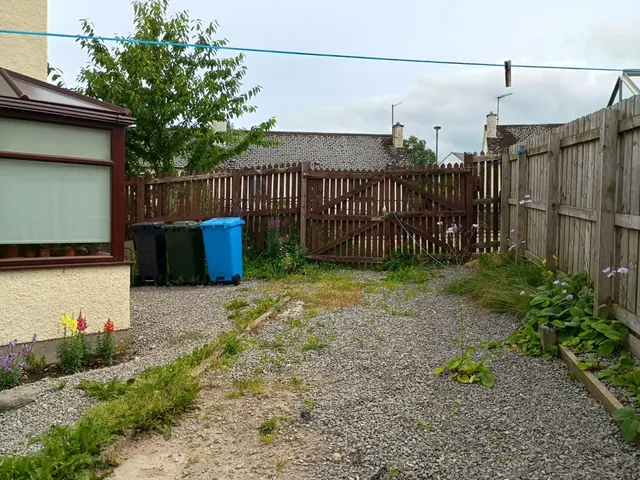 Original garden
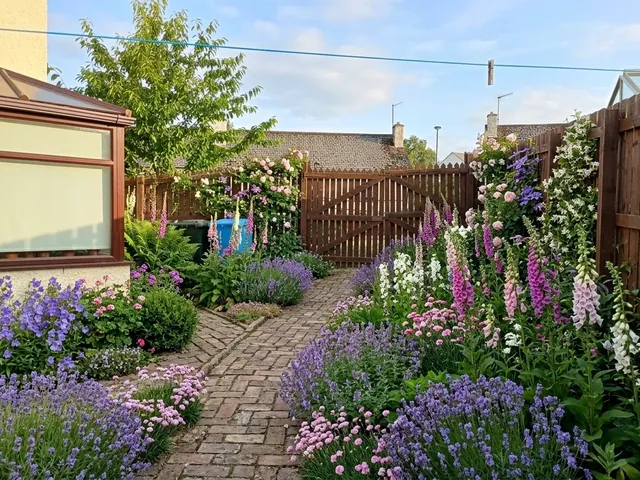 Cottage design
Over 500 garden designs made.
Try a layout before you spend on plants or a designer
If the dome blocks the view down the path or the border looks too dark against your fence, try a second layout while it’s still easy to change. You find out whether the colours sit right in your light before you buy a single plant. Once you’ve found a layout you like, the planting list with Pro or Max tells you what to buy, so you can go to the garden centre with a plan. A garden designer can visit, measure and oversee the build. When you want that help, bring the look you found here.
Start with 3 free designs
Your first 3 designs are free, with no card needed, so you can try the plum, pink and icy blue look three times before you spend anything. Our look is inspired by the Cottesbrooke border; it is not made or approved by the garden or its designer. See how it works on our design my garden page. For more ideas, our cottage garden design page shows real gardens redesigned in the Cottage style, our pastel border ideas page gathers other soft colour schemes, and our famous gardens guide has more great gardens to borrow from.
What you get with Garden Design App
Start free. When you’re ready for a plan you can plant from, choose Pro or Max. One payment, no subscription.
- Free £0
- Your first 3 designs
- Lower quality images with a watermark
- Pro £29
- 20 designs over 14 days
- 5 free designs on top
- 2 designs at once, side by side
- Max £49
- 50 designs over 30 days
- 10 free designs on top
- 4 designs at once, side by side
Turn the design you love into a garden you can plant
Every Pro or Max design comes with a Garden Transformation Pack: the plants, layout, materials and features, with a full care guide.
- Know what to buy. Get plants picked to thrive where you live, in your light and soil. Every plant is named, with the pot size to buy and how tall it grows. For a measured border, you also get how many of each plant to buy.
- Plan the whole garden. Get a layout and the features in your design, plus materials from gravel to fencing with whole garden designs.
- Know what to do through the year. Use the care guide to look after your plants and the flowering calendar to see what comes into bloom next.
- See the detail and ask for changes. Get higher quality images without a watermark, and change any design in your own words.
Your first 3 designs are free, with no card needed.
Questions about Cottesbrooke Hall gardens
Is Cottesbrooke Hall National Trust?
No. Cottesbrooke Hall is a family home: the estate’s website says the Macdonald-Buchanan family bought it in 1936, and three generations have developed the gardens since. The garden is open to visitors; see the Cottesbrooke Hall website for dates. Cottesbrooke Hall
How can I make my garden look like Cottesbrooke?
Give it the things the Statue Walk border is built on: one narrow band of pinks, purples and icy blues, a dark plum undercoat, a few plants repeated along its length and roses on domes for structure. To try the look before you buy plants, add a photo of your garden to Garden Design App, choose Cottage with Plum to peach, and ask for icy blue edging and a rose on a dome in your own words. Your garden is redesigned in just one minute, and your first 3 designs are free.
Who designed the borders at Cottesbrooke Hall?
Gardens Illustrated credits the Statue Walk border to the garden designer Arne Maynard. The estate names Maynard and James Alexander Sinclair as the designers helping the present owners, after earlier work with Geoffrey Jellicoe and Sylvia Crowe. Gardens Illustrated · Cottesbrooke Hall
What plants go in a pink and purple border?
At Cottesbrooke, Gardens Illustrated lists Cercis ‘Forest Pansy’, astrantia ‘Ruby Wedding’, the foxglove ‘Sutton’s Apricot’, the rose The Generous Gardener and the bellflower ‘Prichard’s Variety’, among others. For a pink and purple flower border at home, add a dark undercoat of purple leaves and near black tulips, and a few icy blue flowers to lift it. Our season by season table lists plants with a similar look.
What is a tonal border?
A border planted in one narrow band of related colours rather than a mix. Maynard’s Cottesbrooke border keeps to pinks, purples and icy blues, with dark plums underneath for depth, so it looks restrained without being dull. Gardens Illustrated
How do I make a pastel border look less flat?
Give it something darker underneath. The Cottesbrooke border starts with dark plums and rich pinks, which bring the paler colours to life, and uses cool blues to catch the light. Repeating a few plants along its length stops it looking bitty. Gardens Illustrated
Can you have a pastel border in a small garden?
Yes. Use one of each layer: one purple leaved small tree such as a redbud, one rose on a dome frame and three perennials repeated in groups, edged with one icy blue plant. To check it fits before you plant, try it in Garden Design App with Cottage and Plum to peach; your first 3 designs are free.
About the author
Sources
- Cottesbrooke Hall, Gardens
- The Garden Visitor, Cottesbrooke: a great evolving garden
- Gardens Illustrated, How to create a tonal border from garden design expert, Arne Maynard
- Gardens Illustrated, A year at Allt-y-bela: structure
- Gardenista, A year in Wales with Arne Maynard
- Garden Design App, our plum, pink and icy blue planting theme
- Garden Design App homepage