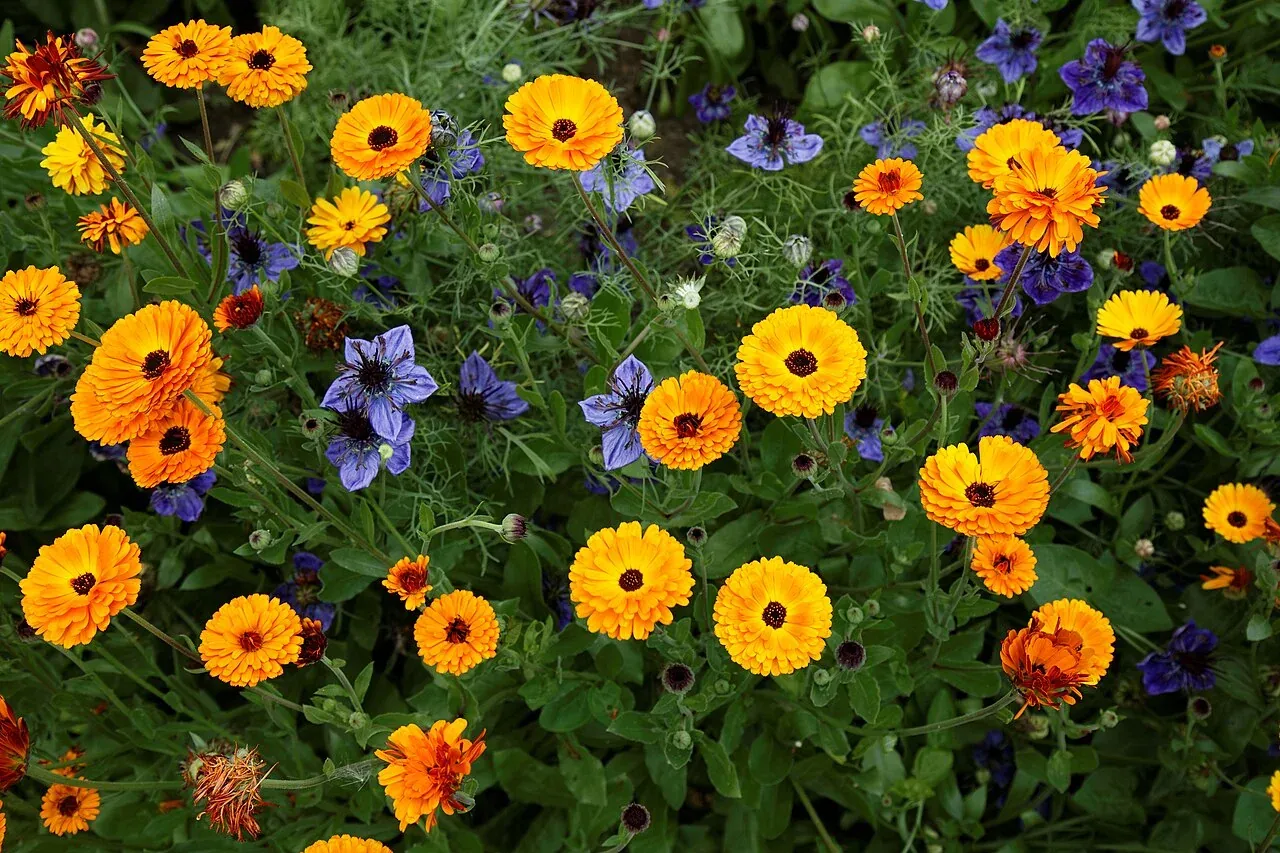

How we can help
How can you transform your garden into a blue and orange cottage garden?
Istvan Dudas keeps adding, moving and replacing plants in his borders so the colour never stops. With Garden Design App, you add a photo of your garden, choose the Cottage style with Blue & orange colours, and ask for the touches you love, such as “electric blue and orange flowers in full borders”: orange tulips over blue squills by the back door, tall delphiniums behind steel blue sea hollies, pot marigolds and cornflowers in the gaps. In just one minute you see your garden redesigned in a look inspired by his, with your house, trees and fences kept.
- See the look before you spend. Bold colour is hard to picture. Will orange tulips against blue scillas look lively by your back door, or too loud? Try orange in every bed, then just a few sparks, and keep the design you love.
- Plants that will grow for you. With Pro or Max, every plant is named and picked to thrive where you live, in your light and soil, ready to buy, with a care guide to grow it well.
- Save over £1,900. The average UK garden design costs £1,950, and a designer can take weeks to months to come back with a first design. Garden Design App gives you one in just one minute.
Your first 3 designs are free, with no card needed.
See a real Cottage garden redesignThe Istvan Dudas garden: a cottage garden with a spark
The Istvan Dudas garden is a private English country garden in Oxfordshire, about two acres, which Dudas designed and looks after himself. When Fine Gardening magazine profiled it in its 200th issue, the garden was eight years old, growing in partial shade on chalky soil he had improved with organic matter. Fine Gardening
The magazine describes his idea as a cottage garden with pizzazz: traditional borders full of soft coloured flowers, kept lively and a little unexpected with bits of bright orange, moments of magenta and splashes of electric blue. Those sparks of electric blue flowers against tangerine flowers are the look this page is about. Fine Gardening
Colour, mostly from flowers, is the key to how he designs, and the magazine picks out his complementary pairing of orange and purple. The feature shows tangerine lupins beside lilac alliums in one bed, and purple salvia mixing with orange pot marigolds in another. Fine Gardening
Dudas changes the garden constantly, adding, moving and replacing annuals and tender perennials, because, as he told the magazine, “I think if we use only shrubs and perennials, it can be very static.” “With my system,” he adds, “I can improve my plant knowledge and be more creative.” In early summer his poppies, pot marigolds, foxgloves and honesty share the borders. In late summer he swaps in heat tolerant plants such as dahlias, giant larkspur flowers and Salvia ‘Amistad’, so the colour keeps going, all mixed with perennials in a meadow style that he says “looks both naturalistic and artistic”. Fine Gardening
He visits and enjoys gardens of all styles, and names Michelin star chefs among his biggest inspirations for their “passion and amazing hard work”. Fine Gardening has run other photo features of the private UK garden he designs and looks after, and has shown autumn pictures from Stockcross House, a different garden where he works as part time head gardener. We found no website for the Oxfordshire garden, so those features are the way to see it. Fine Gardening · Across the Pond · Autumn in a UK Garden
Why a blue and orange garden works
Dudas uses blue and orange as sparks inside soft borders. Our electric blue and tangerine cottage look makes those sparks the whole scheme. Each idea behind it works in an ordinary garden, and these are the ones worth taking home. Our look
Opposites brighten each other
BBC Gardeners’ World calls blue and orange opposites, and says that in brilliant, pure tones the effect can be startling. That is why a few blue and orange flowers lift a whole bed. In our look, steel blue and bronze leaves link the two colours and dark evergreens rest the eye, and we leave out pink, yellow and white flowers so the pairing stays clear. Gardeners’ World
Annuals keep the border moving
Dudas’s system rests on annuals that come and go. In our look, pot marigolds (Calendula officinalis), which grow in his garden, seed themselves into the gaps. A blue cornflower plant beside an orange marigold is the scheme in miniature. Fine Gardening
Tall and loose, mixed with compact
Fine Gardening’s editors praise how his tall, loose plants look airy when massed, with compact ones mixed in to keep the planting interesting. In our look, delphiniums and tall lilies rise behind rounded sea hollies, with low catmint and geums at the front. Across the Pond
One season hands over to the next
Dudas replaces his early summer stars with late summer ones so there is never a gap. Our look plans that hand over across the whole year, so a blue and orange border is never only a summer border: blue bulbs and orange tulips in spring, blue salvias and orange pokers in autumn, blue leaves and coppery witch hazel in winter. Fine Gardening
Repeat the two colours
Fine Gardening’s editors note that simple colour schemes do a lot to tie a garden together. Repeat the same blue and the same orange along a border, rather than one of everything, and the bed reads as one picture. Across the Pond
Find each plant its right place
Dudas loves to try new things and, the magazine says, sees each mistake as a valuable lesson. “I believe that all plants are beautiful,” he says. “We just need to find the right places for them.” If an orange shouts in one spot, it may glow in another. Fine Gardening
Blue plants and flowers through the year, with their orange partners
First, the plants Fine Gardening names in Dudas’s own borders. Then the blue flowering plants and orange partners of our electric blue and tangerine cottage look, season by season. Pot marigolds, poppies, larkspur and Salvia ‘Amistad’ are the plants on this page that Fine Gardening places in Dudas’s garden, along with the others in the first list. Every other plant in the seasonal lists is from our own look. Our look
Plants named in the Istvan Dudas garden
- Poppies and pot marigolds
- Showy annuals of early summer, sharing the borders with foxgloves, honesty, dame’s rocket and white laceflower (Orlaya grandiflora). Fine Gardening
- Giant larkspur, dahlias and Salvia ‘Amistad’
- The heat tolerant plants he swaps in for late summer, with Queen Anne’s lace (Ammi majus). Fine Gardening
- Tangerine lupins and lilac alliums
- The pairing that steals the scene in one bed; purple salvia and orange pot marigolds mix in another. Fine Gardening
In the autumn photos from Stockcross House, the different garden where Dudas is part time head gardener, Fine Gardening points out the small blue flowers of what looks to be Salvia uliginosa, with yellow sneezeweed and white Japanese anemones. Autumn in a UK Garden
Blue flowering plants and orange partners by season
Spring starts in February with blue flowers low down: the dwarf Iris ‘Harmony’, the pale Iris ‘Katharine Hodgkin’ and squills (Scilla siberica). These bulbs give way to grape hyacinths under orange tulips such as ‘Daydream’ and ‘Prinses Irene’. In May, blue camassias rise through the tulips and the orange oriental poppy ‘Allegro’ opens. The evergreen ceanothus ‘Concha’ is the blue flowering bush of the season, beside Berberis darwinii hung with orange flowers.
Summer brings the boldest blues. Delphinium ‘Faust’ stands at the back, with the steel blue sea holly Eryngium × zabelii ‘Big Blue’ and the globe thistle Echinops bannaticus ‘Taplow Blue’ in the middle. Agapanthus ‘Northern Star’ adds see through heads. Against them sit orange perennials: Geum ‘Totally Tangerine’, which flowers from May to October, Achillea ‘Terracotta’ and the tall Lilium henryi. On a fence, the blue Clematis ‘Perle d’Azur’ climbs beside the amber honeysuckle Lonicera × tellmanniana.
Autumn belongs to blue salvias: Salvia guaranitica ‘Blue Enigma’ flowers into late autumn beside the orange pokers of Kniphofia rooperi and the late crocosmia ‘Star of the East’, while Hakonechloa ‘Nicolas’ and the small tree Sorbus ‘Dodong’ turn orange. Winter is carried by the coppery witch hazel ‘Jelena’ and orange dogwood stems against blue fescue and Yucca rostrata.
| Season | What to plant |
|---|---|
| Spring | Blue flowers Dwarf iris ‘Harmony’, squills, grape hyacinths, camassias, ceanothus ‘Concha’. Orange partners Tulips ‘Daydream’ and ‘Prinses Irene’, wallflower ‘Apricot Twist’, poppy ‘Allegro’. |
| Summer | Blue flowers Delphinium ‘Faust’, sea holly ‘Big Blue’, globe thistle, agapanthus, cornflower, catmint, Clematis ‘Perle d’Azur’. Orange partners Geum ‘Totally Tangerine’, pot marigolds, Achillea ‘Terracotta’, daylily, Lilium henryi. |
| Autumn | Blue flowers Salvia ‘Blue Enigma’, ceratostigma, aster ‘Mönch’, Salvia ‘Amistad’ (violet). Orange partners Kniphofia rooperi, crocosmia, Helenium ‘Waltraut’, Sorbus ‘Dodong’. |
| Winter | Blue leaves Blue fescue and Yucca rostrata, both for their blue leaves. Orange partners Witch hazel ‘Jelena’, apricot hellebore, dogwood ‘Midwinter Fire’. |
How to plant a blue and orange border in an ordinary garden
The look depends on pairing the colours and keeping beds full, which works at any size. Start with one bed you can see from the house or walk past often, and try the pairs there before buying for the rest of the garden. For more blue flowers in the wider cottage style, our cottage garden plants page lists the classics.
In a small garden
Choose one blue and one orange for each season and repeat them. Keep low plants at the front, such as squills, the dwarf agapanthus Brilliant Blue and Geum ‘Totally Tangerine’, and use the fences for height with Clematis ‘Perle d’Azur’ and the orange honeysuckle. For a tree, Sorbus ‘Dodong’ is small and turns flame orange in autumn.
In part shade
Dudas’s own garden is in partial shade. Gardeners’ World advises that hot colours show best in bright sunlight and pale colours are best in shade, where they are seen more clearly. Give the oranges your sunniest spots, and put paler blues, such as Iris ‘Katharine Hodgkin’ and blue windflowers (Anemone blanda), under shrubs. Gardeners’ World
On a tight budget
Start with annuals, as Dudas does. Pot marigolds and cornflowers fill gaps and seed themselves for next year. Add blue flower bulbs in autumn for spring, then build up blue perennials, such as catmint and Geranium ‘Johnson’s Blue’, a few at a time.
What to do first
Watch where the sun falls, because that decides where the orange goes. Place a few evergreens to hold the bed in winter, such as Berberis darwinii or the low ceanothus, then fill around them with blue perennials and orange perennials. Before you buy, see the whole bed redesigned so you know the colours sit where you want them.
Garden Design App
How can we help you transform your garden into a blue and orange cottage garden?
A blue and orange garden is a bold choice, and bold choices are the ones people hesitate over. It is hard to plan in your head: orange in every bed can shout, a few sparks can get lost in a big border, and a pairing that looks right in a catalogue may not suit your brick or fence. Mistakes cost money, and a whole season to find out. Garden Design App takes the guesswork away. It redesigns your own garden in an electric blue and tangerine cottage look, one border or the whole garden, so you find out whether you want orange in every bed or just a few sparks, as Dudas uses them, before you spend on plants.
Think of a sunny evening in July: tall blue delphiniums at the back of the border, steel blue sea holly heads catching the low light, tangerine geums and orange pot marigolds glowing at the front, and blue cornflowers seeding into the gaps between them. On the fence a sky blue clematis climbs beside an amber honeysuckle, and as you walk down the path the oranges sit in the sun, where hot colours show best. In spring it starts again by the back door, with scented blue hyacinths and orange tulips over a carpet of blue squills. Ask for exactly that, and the app draws it into your garden, around the house, trees and fences you already have.
What you can ask for
Type any of these into the “Anything else?” box, in your own words:
- Orange tulips over a carpet of blue squills by the back door
- Tall blue delphiniums at the back, with steel blue sea hollies in front of them
- Orange pot marigolds and blue cornflowers filling the gaps between the perennials
- A blue clematis on the fence beside an orange honeysuckle
- The oranges in the sunniest spot, with paler blues under the shrubs
- Blue salvias and orange crocosmia to carry the colour into autumn
How to design a blue and orange cottage garden in five steps
- Start a free garden design. Press “Start my free garden design” and add a photo of the part of the garden you want to transform. Your house, trees and fences stay where they are.
- Choose Cottage for the style, then pick Blue & orange for the colours. Dudas’s borders are a cottage garden at heart, full of soft coloured flowers, which is why Cottage is the place to start. If the bed gets only part of the day’s sun, as his garden does, pick Part sun (3–6 hrs) for the light too.
-
Ask for the blue and orange touches you love in the “Anything else?” box.
“Put orange tulips over blue squills by the back door and tall blue delphiniums behind steel blue sea hollies. Fill the gaps with orange pot marigolds and blue cornflowers, and keep the oranges in the sunniest spot.”
- See your garden transformed in just one minute. Look at the orange against the house, trees and fences the app keeps, and know whether it suits them before you spend a penny on plants. Change your mind and ask again: try orange in every bed, then just a few sparks, and keep the one you love.
- Turn it into a garden you can plant. With Pro or Max (£29 or £49, paid once), every plant in your design is named, picked for your light and soil and ready to buy, with the pot size and how tall it grows. A care guide and flowering calendar keep the hand over going, so the blue and orange carries on from spring bulbs to autumn salvias.
Why try it with Garden Design App first?
No guesswork
You don’t need to know the name of a single plant. You see the blue and orange against your own fence, lawn and patio before you spend anything on it, and if the orange shouts beside your brickwork, you try fewer sparks.
Plants that will thrive
Pro and Max pick every plant to thrive where you live, in your light and soil, and name each one ready to buy. That matters in a look where the oranges want sun and the paler blues can sit in shade, and measured borders also tell you how many of each to buy.
Your garden stays familiar
Your house, trees and fences stay where they are, so the design fits the garden you already have, whether that’s one border or the whole plot.
A design in just one minute
A garden designer can take weeks to months to come back with a first design, and the average UK garden design costs £1,950. Save over £1,900, and start today with 3 free designs.
A real garden, before and after
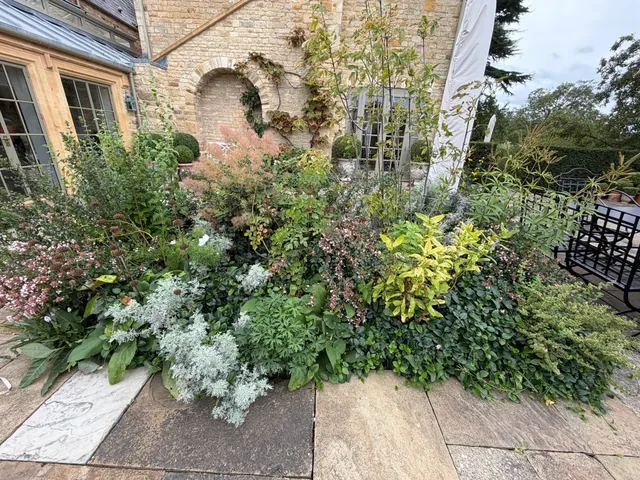 Original garden
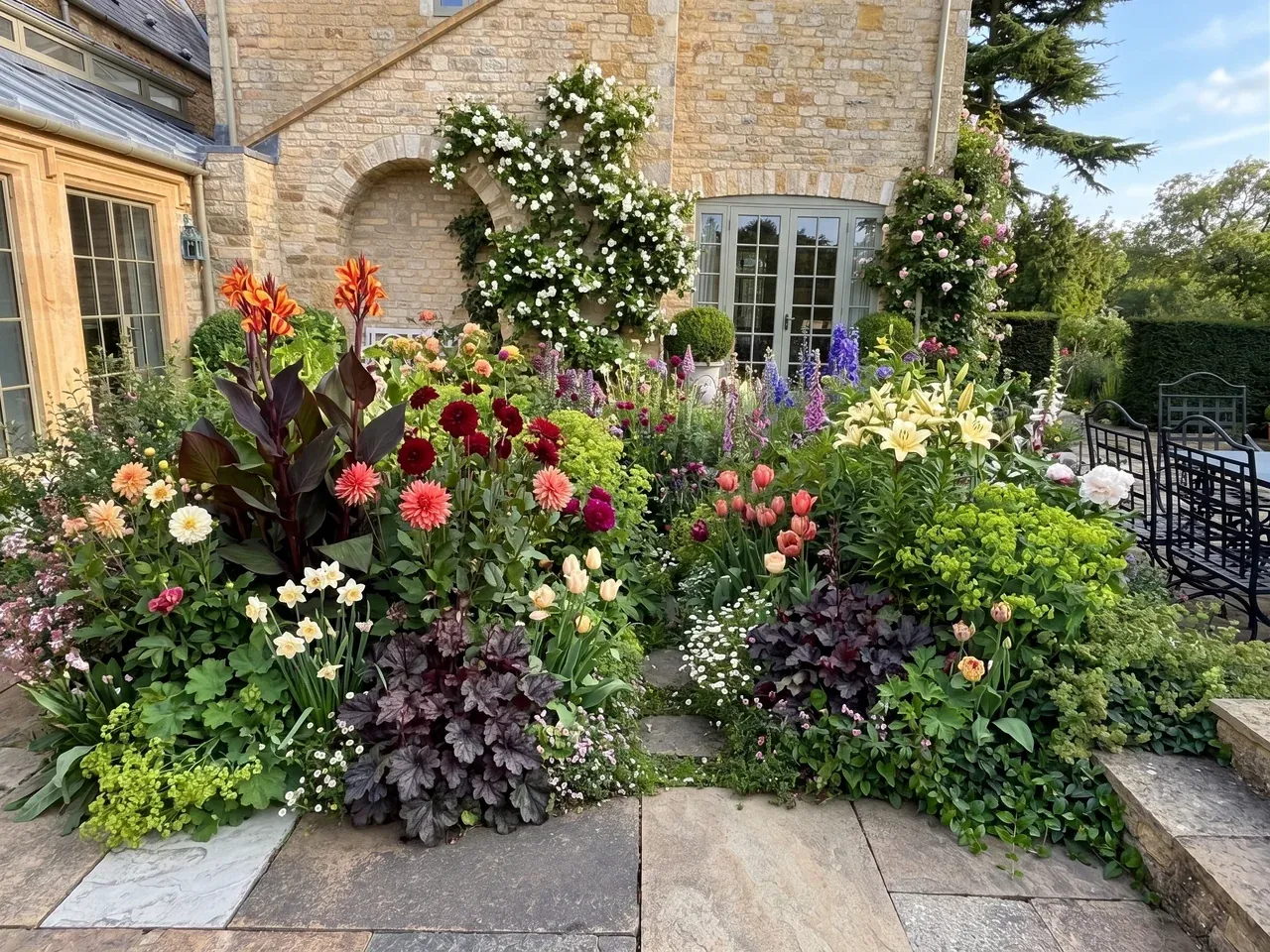 Cottage design
Over 500 garden designs made.
Try a layout before you spend on plants or a designer
If the orange feels too loud beside your house, or the delphiniums hide the view down the garden, try a second layout while it’s still easy to change. Once you’ve found a layout you like, the planting list with Pro or Max tells you what to buy, so you can go to the garden centre with a plan. A garden designer can visit, measure and oversee the build. When you want that help, bring the look you found here.
Start with 3 free designs
Your first 3 designs are free, with no card needed, so you can try the blue and orange look three times before you spend anything: orange in every bed, just a few sparks, and one with a blue clematis on the fence. For more ideas, our cottage garden design page shows real gardens redesigned in the Cottage style, our design my garden page shows how it works, our blue and purple border ideas page has more ways to plant in blue, and our famous gardens guide gathers other gardens to borrow from.
What you get with Garden Design App
Start free. When you’re ready for a plan you can plant from, choose Pro or Max. One payment, no subscription.
- Free £0
- Your first 3 designs
- Lower quality images with a watermark
- Pro £29
- 20 designs over 14 days
- 5 free designs on top
- 2 designs at once, side by side
- Max £49
- 50 designs over 30 days
- 10 free designs on top
- 4 designs at once, side by side
Turn the design you love into a garden you can plant
Every Pro or Max design comes with a Garden Transformation Pack: the plants, layout, materials and features, with a full care guide.
- Know what to buy. Get plants picked to thrive where you live, in your light and soil. Every plant is named, with the pot size to buy and how tall it grows. For a measured border, you also get how many of each plant to buy.
- Plan the whole garden. Get a layout and the features in your design, plus materials from gravel to fencing with whole garden designs.
- Know what to do through the year. Use the care guide to look after your plants and the flowering calendar to see what comes into bloom next.
- See the detail and ask for changes. Get higher quality images without a watermark, and change any design in your own words.
Your first 3 designs are free, with no card needed.
Questions about blue and orange gardens
What blue flowering plants go with orange?
Gardeners’ World pairs orange kniphofias, achilleas and echinaceas with silvery blue eryngiums, echinops and perovskia. In our look, squills sit under orange tulips in spring, delphiniums and agapanthus join the summer pairs, and blue salvias meet crocosmia in autumn. Gardeners’ World
How can I make my garden look like a blue and orange cottage garden?
Pair one blue with one orange each season and repeat them: squills under orange tulips in spring, delphiniums and sea hollies with geums and pot marigolds in summer, blue salvias with crocosmia in autumn. Give the oranges your sunniest spot. To try the look before you buy plants, add a photo of your garden to Garden Design App, choose Cottage with Blue & orange, and ask for the pairs you love in your own words. Your garden is redesigned in just one minute, and your first 3 designs are free.
Do blue and orange flowers go together in a cottage garden?
Yes. Istvan Dudas adds splashes of electric blue and bright orange to soft cottage borders in his Oxfordshire garden to keep them lively. Gardeners’ World calls blue and orange opposites, startling in pure tones, so a few repeated pairs go a long way. Fine Gardening · Gardeners’ World
Can I grow a blue and orange border in part shade?
Yes, with care over where each colour goes. Dudas’s own garden is in partial shade. Gardeners’ World says hot colours look best in bright sunlight and pale colours in shade, so give the oranges your sunniest spots and use paler blues where the light is lower. Gardeners’ World
What are good blue perennials for a border?
In our look: delphiniums at the back, sea hollies and globe thistles in the middle, agapanthus for see through heads, Geranium ‘Johnson’s Blue’ and catmint at the front, and Salvia ‘Blue Enigma’ to carry blue into late autumn. Our season by season list pairs each with an orange partner.
Who is Istvan Dudas?
Fine Gardening calls him a creative plantsman. He designed and looks after a private two acre cottage garden in Oxfordshire, the magazine describes him as the caretaker and designer of a private UK garden, and he is part time head gardener at Stockcross House. Fine Gardening · Across the Pond · Autumn in a UK Garden
Can I visit Istvan Dudas’s garden?
Fine Gardening describes it as a private garden, and we found no website or visiting details for it. The magazine’s photo features of his work are the way to see it. Fine Gardening
About the author
Sources
- Fine Gardening, An English Country Garden in Summer by Kaitlyn Hayes, issue 200
- Fine Gardening, Design Inspiration From Across the Pond
- Fine Gardening, Autumn in a UK Garden
- BBC Gardeners’ World, Six garden colour schemes to try
- Our own planting list for the electric blue and tangerine cottage look, Garden Design App
- Garden Design App homepage