
How we can help
How can you transform your garden to look like Gertrude Jekyll’s colour border?
Jekyll worked out her border over years of trial at Munstead Wood. With Garden Design App, you add a photo of your garden, choose the Cottage style with the graded colour Blue to gold, and ask for the Jekyll touches you love, such as “a long border from blue and silver at each end to scarlet and gold in the middle”. In just one minute you see your garden redesigned as a graded colour border inspired by Gertrude Jekyll, with your house, trees and fences kept.
- See the look before you spend. A graded border is hard to picture from a plan: where does the blue stop and the gold begin, and will the reds look gorgeous or garish next to your fence? Try the blues at the house end, then at the far end, and keep the design you love.
- Plants that will grow for you. With Pro or Max, every plant is named and picked to thrive where you live, in your light and soil, ready to buy, with a care guide to grow it well.
- Save over £1,900. The average UK garden design costs £1,950, and a designer can take weeks to months to come back with a first design. Garden Design App gives you one in just one minute.
Your first 3 designs are free, with no card needed.
See a real Cottage garden redesignGertrude Jekyll at Munstead Wood: who she was and what she made
Gertrude Jekyll was born in Mayfair, London, in 1843 and grew up at Bramley House in Surrey. She trained at the South Kensington School of Art and meant to be a painter, inspired by John Ruskin and William Morris. Wikipedia notes the suggestion that failing eyesight largely ended her painting. She kept thinking like a painter: Country Life says she took the colour theories of Michel-Eugène Chevreul, already used for bedding schemes, and applied them to hardy plants. Garden history · Country Life
In 1889 she met the young architect Edwin Lutyens, and the partnership of Gertrude Jekyll and Edwin Lutyens became one of the best known of the Arts and Crafts movement. Munstead Wood, near Godalming, was their first house and garden project: Lutyens designed the house in the mid 1890s in the middle of a garden she was already shaping, in local Bargate stone, with plain sand paths between the borders. Garden history · Country Life
Munstead Wood was Gertrude Jekyll’s house for the rest of her life, and she died there in 1932. At Munstead Wood she made a garden of separate parts, each given to a season or a colour scheme, loosening into informal planting at the woodland edge. Her Munstead Wood garden fed her books, from Wood and Garden (1899) to her 1908 book on colour, best known as Colour Schemes for the Flower Garden, with fold out plans of its borders. Garden history · Country Life
By her death she had designed or planted some 400 gardens. Most of the gardens designed by Gertrude Jekyll are lost, but Wikipedia lists several that have been restored: her own garden at Munstead Wood, Hestercombe, The Croft at Brook in Surrey, Woolverstone House, Durmast House, and the Manor House at Upton Grey in Hampshire, where her long border has been replanted. The National Trust bought Munstead Wood in 2023; for visiting, see the National Trust’s own page. Our famous gardens guide gathers other great British gardens and the ideas worth borrowing from each. Garden history
The long border: a colour wheel laid out flat
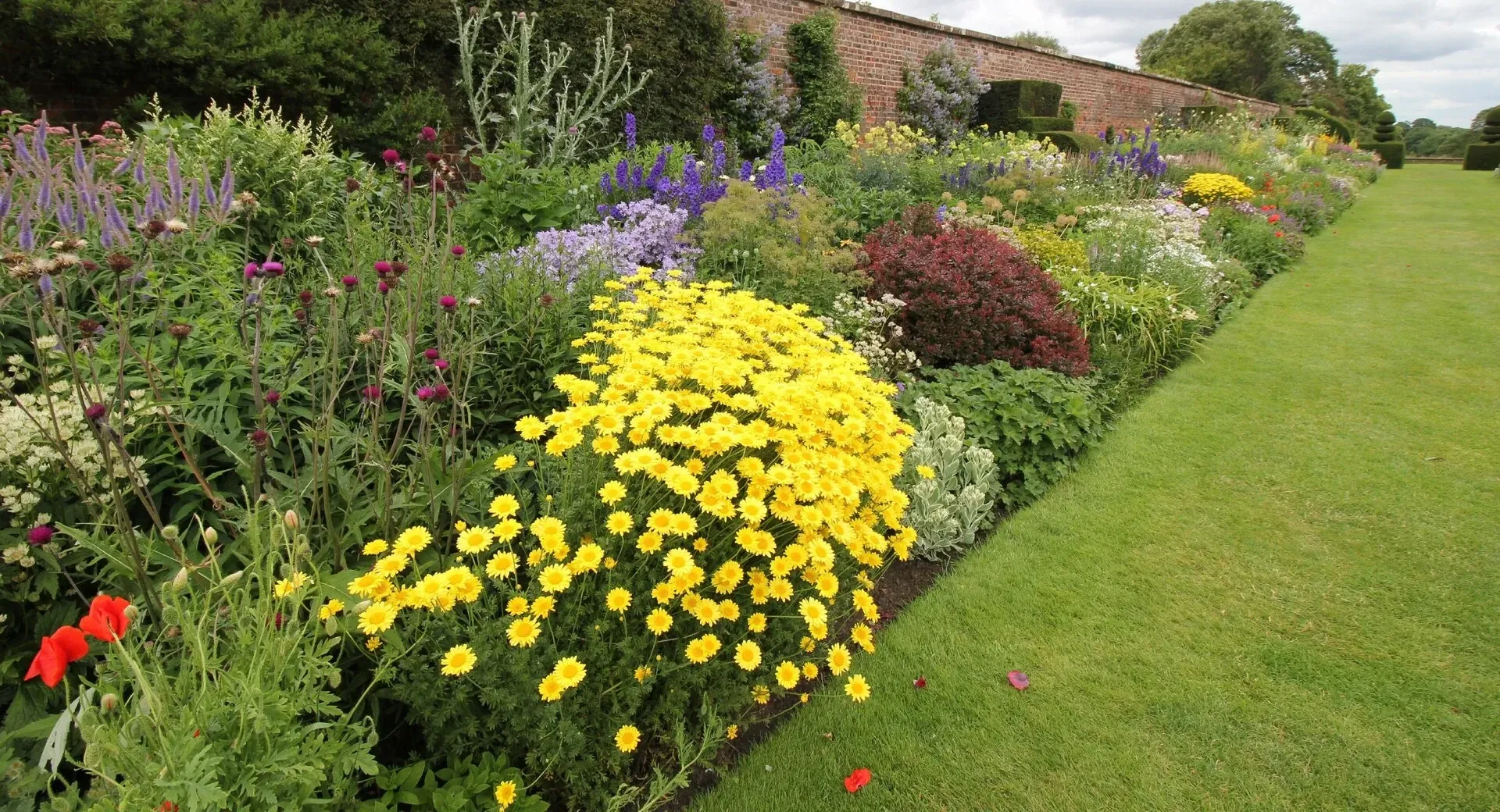
The main border at Munstead Wood was about two hundred feet long and fourteen feet wide, backed by a sandstone wall about eleven feet high, covered in evergreens such as bay, laurustinus, Mexican orange blossom (Choisya) and cistus. In Jekyll’s words: “At the two ends there is a groundwork of grey and glaucous foliage”, among it lamb’s ears (Stachys), cotton lavender (Santolina) and yuccas. Colour in the Flower Garden
At the western end the flowers were pure blue, grey blue, white, palest yellow and palest pink. The colour then strengthened through yellow to orange and red: “By the time the middle space of the border is reached the colour is strong and gorgeous, but, as it is in good harmonies, it is never garish.” Then it cooled again through deep yellow to pale yellow, white and pink, ending in purples and lilacs instead of blues. Country Life sums it up as a colour wheel stretched out flat, each colour group balanced by touches of its opposite and steadied by grey and white. Colour in the Flower Garden · Country Life
This long border is the heart of any Jekyll garden, and the idea a homeowner can borrow most easily, whatever the size of the plot. Why it works comes down to six Gertrude Jekyll design principles you can use at home.
Grade the colour, never mix it
The core of the Gertrude Jekyll colour wheel is that neighbours sit next to neighbours: blue beside white, white beside pale yellow, yellow beside orange. The eye travels along the border instead of jumping about, so even strong reds look rich rather than loud. In her own words, she liked to use colour “as a general rule in harmonies rather than contrasts”. Colour in the Flower Garden
Calm the ends with silver
Grey and blue green leaves at each end do the work of white space on a page, and give the hot middle something to glow against. At Munstead Wood that groundwork was lamb’s ears, cotton lavender and yuccas. Colour in the Flower Garden
Keep blues and purples apart
Jekyll wrote, “I have a dislike to bringing together blues and purples”, so the blues sat at one end and the purples at the other. It stops a border looking muddy. Colour in the Flower Garden
Give each part a season
She found it best “to devote one space at a time, sometimes mainly, sometimes entirely, to the flowers of one season of the year”. In a smaller garden, one bed for spring bulbs and one border for summer does the same job. Colour in the Flower Garden
Plan for the gaps
Jekyll set oriental poppies beside gypsophila, which grew over the poppies once they faded, and dropped in annuals to keep the effect going. In Wood and Garden she says that by July there is a delicate cloud of bloom instead of large bare patches. Colour in the Flower Garden · Wood and Garden · Country Life
Repeat the structure
Repeating the yuccas, bergenias and silver edging that Country Life lists as her signature holds the border together in every month. Behind them, the evergreens on the wall show, in her words, “as a handsome background to the flowering plants”. Country Life · Colour in the Flower Garden
Gertrude Jekyll plants through the year
These Gertrude Jekyll plants are the ones in our Jekyll border look, each chosen for a role she describes; only where we say so did she grow the plant herself. First, the plants Jekyll names in her own garden at Munstead Wood. Then our look, season by season, from the cool end through the hot middle to the far end.
Munstead Wood plant list from Jekyll’s own books
- Lamb’s ears, cotton lavender and yuccas
- The grey and glaucous groundwork at both ends of the main border. Colour in the Flower Garden
- Delphiniums and the milky bellflower
- Cool end plants she grew in the border, the bellflower being Campanula lactiflora. Colour in the Flower Garden
- Bay, laurustinus, Choisya and cistus
- The evergreens covering the sandstone wall behind the border, Choisya being Mexican orange blossom. Colour in the Flower Garden
- Oriental poppies and gypsophila
- Planted side by side, so the gypsophila grew over the poppies once they faded. Colour in the Flower Garden
- Great spurge
- Euphorbia characias subsp. wulfenii, which she called one of the grandest of plants. Colour in the Flower Garden
- Holly
- Praised for “its solid masses of full, deep colour” in winter. Wood and Garden
Country Life lists yuccas, bergenias and silver edging such as lamb’s ears among her signatures. Russian sage was a plant she wished for: in Colour in the Flower Garden she wrote that one group would have been all the better for the beautiful blue flowered Perowskya, which she did not know when she planted it. Country Life · Colour in the Flower Garden
Plants for a Jekyll border at home
Our cottage theme inspired by Gertrude Jekyll grades every season the same way: cool colours at the near end, hot colours in the middle and purples at the far end. Each season below gives the plants in our look, then what to put at each end and in the middle. Start with a plant or two for each part, and repeat them along the border.
| Season | What to plant |
|---|---|
| Spring | Pale bulbs in front, dark colours behind Our look puts white windflowers (Anemone blanda ‘White Splendour’), Siberian squill (Scilla siberica), ‘Delft Blue’ hyacinths and drifts of white tulips at the front, with the dark tulip ‘Queen of Night’ and the purple wallflower ‘Bowles’s Mauve’ (Erysimum) behind, as in her spring garden. Great spurge (Euphorbia characias subsp. wulfenii), which she called one of the grandest of plants, is the focal point. Cool end: white anemones, blue hyacinths, white tulips. Hot middle: yellow wallflowers, crown imperials. Far end: ‘Bowles’s Mauve’ wallflower, ‘Queen of Night’ tulips. |
| Summer | Silver and blue, then gold and scarlet The cool end is lamb’s ears, cotton lavender (Santolina chamaecyparissus), delphiniums and the milky bellflower (Campanula lactiflora), all plants she grew in the border; for the lamb’s ears our look picks the variety Stachys byzantina ‘Cotton Boll’. The middle warms through golden yarrow (Achillea ‘Gold Plate’), scarlet phlox, penstemon and bee balm (Monarda) to the dark hollyhock ‘Nigra’ (Alcea rosea), then cools again with catmint (Nepeta) and globe thistle (Echinops). Cool end: lamb’s ears, cotton lavender, delphiniums. Hot middle: golden yarrow, scarlet phlox, dark hollyhocks. Far end: catmint, globe thistle, Clematis ‘Jackmanii’. |
| Autumn | The colour carries on Michaelmas daisies, tall yellow coneflowers (Rudbeckia laciniata), the dahlia ‘Bishop of Llandaff’ and pokers (Kniphofia) carry the colour on, with Russian sage (Salvia yangii), a plant she wished for. Cool end: Russian sage, pale pink dahlia ‘Café au Lait’. Hot middle: yellow rudbeckia, scarlet dahlias, pokers. Far end: Michaelmas daisies, nerines. |
| Winter | Holly and evergreens take over Then holly takes over, the plant she praised for “its solid masses of full, deep colour”, joined in our look by laurustinus (Viburnum tinus), red stemmed dogwood (Cornus alba ‘Sibirica’) and a pale witch hazel (Hamamelis ‘Pallida’) for scent. Cool end: holly, laurustinus, bay. Hot middle: pale witch hazel. Far end: bergenia leaves turning purple red. |
How to plant a graded colour border inspired by Gertrude Jekyll
Jekyll’s main border was about two hundred feet long, but the idea works in an ordinary garden. Start with one border you can see from the house or walk past often, and set the grading there before you buy for the rest of the garden.
Start with the backbone
Before any flowers, plant the evergreens and the silver: a holly or bay at the back, lamb’s ears and cotton lavender along the front at both ends. They keep the border looking finished in winter. Against a fence rather than a wall, a laurustinus or Choisya does the job of her wall shrubs.
Shrink the sequence
In a small garden, shrink the sequence, not the idea. One fence can run from blue and silver nearest the house, through yellow, to a block of red in the middle and lilac at the far end. If you only have room for one half, our blue and purple border and hot colour border pages show each on its own.
Plant in bigger groups
Use fewer colours in bigger groups: three of one plant reads as a drift, one of each reads as a jumble. Jekyll came to the view that in all flower borders it is better to plant in long rather than block shaped patches, so a group that has finished leaves no empty space behind it. Colour in the Flower Garden
Put the hot middle in the sun
In part shade, put the hot middle where the sun is strongest and the pale end in the shade, with hellebores, epimediums and white foxgloves, where pale colours glow. Our shade garden design page has more for the darker corners.
On a tight budget, sow
Buy the structure and sow the rest. Evergreens and a few perennials are the spend; nasturtiums, honesty and foxgloves come cheaply from seed, much as Jekyll dropped annuals into gaps. For more plants in the same spirit, our cottage garden plants page lists the ones that suit a British garden.
Mark the change points first
What to do first: decide which end is cool and which is hot, and mark the change points with canes. Plant cool end, middle, then far end, so the grading is set before a favourite plant breaks it. Our herbaceous border planner helps you lay the border out, and our cottage garden design page shows the wider style this sits in.
Garden Design App
How can we help you transform your garden to look like Gertrude Jekyll’s colour border?
Planning a graded colour border is hard to do in your head. The hardest part is the bit you cannot see on paper: whether the change from blue to gold falls in the right place, and how the hot middle sits against your own fence, lawn and house. Put the reds in the wrong spot and they look garish instead of gorgeous, and a mistake costs money and a whole season to find out. Jekyll worked out her garden design over years of trial at Munstead Wood; you can skip the guesswork. Garden Design App redesigns your own garden as a graded colour border, one border or the whole garden, so you see the result before you buy a single plant.
Think of a summer evening walk along the border from the house: silver lamb’s ears and cotton lavender at your feet and blue delphiniums rising behind them, then the colour strengthening step by step through golden yarrow to scarlet phlox and dark hollyhocks in the middle, strong and gorgeous but never garish. Walk on and it cools again, through pale yellow to catmint, globe thistle and a purple clematis at the far end, with holly and bay behind holding it all steady and the scent of catmint rising as you brush past. Ask for exactly that, and the app draws it into your garden, around the house, trees and fences you already have.
What you can ask for
Type any of these into the “Anything else?” box, in your own words:
- Blue and silver at the house end, warming through yellow and orange to scarlet in the middle
- Purples and lilacs at the far end, kept well away from the blues
- Silver leaves along the front at both ends, such as lamb’s ears and cotton lavender
- A holly or bay at the back, or a laurustinus against the fence, so the border looks finished in winter
- Yuccas and bergenias repeated down the border to hold it together
- A bed of spring bulbs in front, with dark tulips and purple wallflowers behind
How to design a graded colour border in five steps
- Start a free garden design. Press “Start my free garden design” and add a photo of the part of the garden you want to transform. Your house, trees and fences stay where they are.
- Choose Cottage for the style, then pick Blue to gold for the colours, under “Graded colour: changes along the border”. A border that changes colour along its length is exactly what Jekyll made, so it is the natural place to start.
-
Ask for the Jekyll touches you love in the “Anything else?” box.
“Run the border from blue and silver at the house end, through yellow and orange to scarlet and gold in the middle, then back to purples and lilacs at the far end. Put silver leaves along the front at both ends and a holly at the back.”
- See your garden transformed in just one minute. Look at where the change from blue to gold falls against the house, trees and fences the app keeps. Try versions one after another: blues at the house end or the far end, one long border or two facing across a path, and keep the one you love.
- Turn it into a garden you can plant. With Pro or Max (£29 or £49, paid once), every plant in your design is named, chosen for your light and soil and ready to buy, with the pot size and how tall it grows. A care guide helps you grow it well, and a flowering calendar shows the colours moving along the border through the year.
Why try it with Garden Design App first?
No guesswork
You don’t need to know the name of a single plant. You see the colours run against your own fence, lawn and patio before you spend anything on them, and if the reds sit too close to the house, you move the hot middle along.
Plants that will thrive
Pro and Max pick every plant to thrive where you live, in your light and soil, and name each one ready to buy. Measured borders also tell you how many of each to buy, so every drift comes out big enough to read as a drift.
Your garden stays familiar
Your house, trees and fences stay where they are, so the design fits the garden you already have, whether that’s one border or the whole plot.
A design in just one minute
A garden designer can take weeks to months to come back with a first design, and the average UK garden design costs £1,950. Save over £1,900, and start today with 3 free designs.
A real garden, before and after
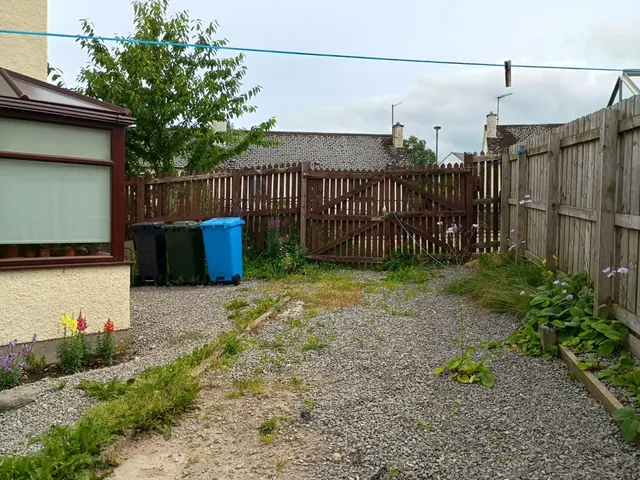 Original garden
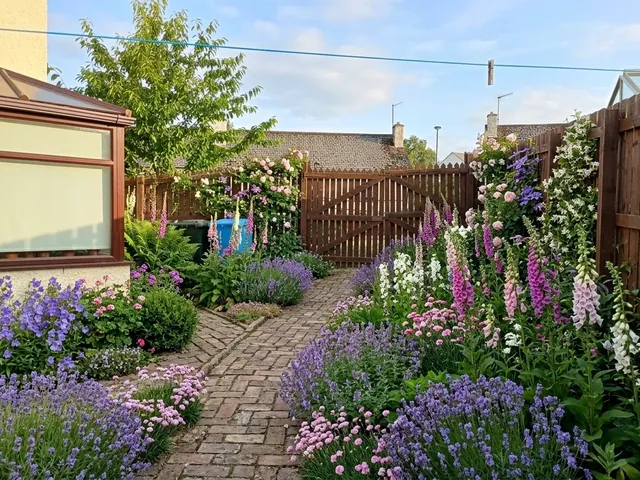 Cottage design
Over 500 garden designs made.
Try a layout before you spend on plants or a designer
If the change from blue to gold falls in the wrong place, or the hot middle feels too loud beside the house, try a second layout while it’s still easy to change. Once you’ve found a layout you like, the planting list with Pro or Max tells you what to buy, so you can go to the garden centre with a plan. A garden designer can visit, measure and oversee the build. When you want that help, bring the look you found here.
Start with 3 free designs
Your first 3 designs are free, with no card needed, so you can try the Jekyll border three times before you spend anything: blues at the house end, blues at the far end, and two borders facing across a path. For more ideas, our cottage garden design page shows real gardens redesigned in the Cottage style, our design my garden page shows how it works, and our famous gardens guide has more great gardens to borrow from.
What you get with Garden Design App
Start free. When you’re ready for a plan you can plant from, choose Pro or Max. One payment, no subscription.
- Free £0
- Your first 3 designs
- Lower quality images with a watermark
- Pro £29
- 20 designs over 14 days
- 5 free designs on top
- 2 designs at once, side by side
- Max £49
- 50 designs over 30 days
- 10 free designs on top
- 4 designs at once, side by side
Turn the design you love into a garden you can plant
Every Pro or Max design comes with a Garden Transformation Pack: the plants, layout, materials and features, with a full care guide.
- Know what to buy. Get plants picked to thrive where you live, in your light and soil. Every plant is named, with the pot size to buy and how tall it grows. For a measured border, you also get how many of each plant to buy.
- Plan the whole garden. Get a layout and the features in your design, plus materials from gravel to fencing with whole garden designs.
- Know what to do through the year. Use the care guide to look after your plants and the flowering calendar to see what comes into bloom next.
- See the detail and ask for changes. Get higher quality images without a watermark, and change any design in your own words.
Your first 3 designs are free, with no card needed.
Questions about Gertrude Jekyll
Who was Gertrude Jekyll?
A British garden designer, writer, photographer and craftswoman (1843 to 1932) who trained as a painter. Working with the architect Edwin Lutyens and from her own garden at Munstead Wood in Surrey, she shaped the colour graded hardy flower border, and designed or planted some 400 gardens. Garden history · Country Life
How can I make my garden look like a Gertrude Jekyll border?
Give it the three things her long border is built on: cool colours and silver leaves at each end, hot colours in the middle, and evergreens behind it for winter. To try the look before you buy plants, add a photo of your garden to Garden Design App, choose Cottage with Blue to gold, and ask for scarlet and gold in the middle and purples at the far end in your own words. Your garden is redesigned in just one minute, and your first 3 designs are free.
What is the most famous Gertrude Jekyll garden?
Munstead Wood, her own garden in Surrey. She worked out her graded colour border there, and it was her home for the rest of her life. Garden history
Are there Gertrude Jekyll gardens to visit today?
Wikipedia lists restored Jekyll gardens including Munstead Wood, Hestercombe, The Croft at Brook, Woolverstone House, Durmast House and the Manor House at Upton Grey. Opening arrangements change, so check each garden’s own website before you go. Garden history
Was Gertrude Jekyll married?
No. Wikipedia records that she never married. She lived with her mother until 1895, when she moved into her own house, Munstead Wood, across the way. Garden history
Did Gertrude Jekyll have poor eyesight?
Some writers suggest so. Wikipedia notes the suggestion that deteriorating eyesight largely ended her career as a painter, and that it may explain the soft, Impressionist look of her planting. Garden history
What is the Gertrude Jekyll colour wheel?
A way of describing her long border: colours in the order they sit on a colour wheel, laid out in a line. Blues, white and palest yellow at the western end warm through yellow and orange to red in the middle, then cool again to purples and lilacs at the eastern end, with grey foliage and white steadying the scheme. Country Life · Colour in the Flower Garden
What makes an arts and crafts garden?
At Munstead Wood it meant local Bargate stone, sand paths between the borders, evergreens such as yucca and bergenia for structure, and drifts of hardy plants arranged by colour. Country Life