
How we can help
How can you transform your garden to look like the Jewel Garden?
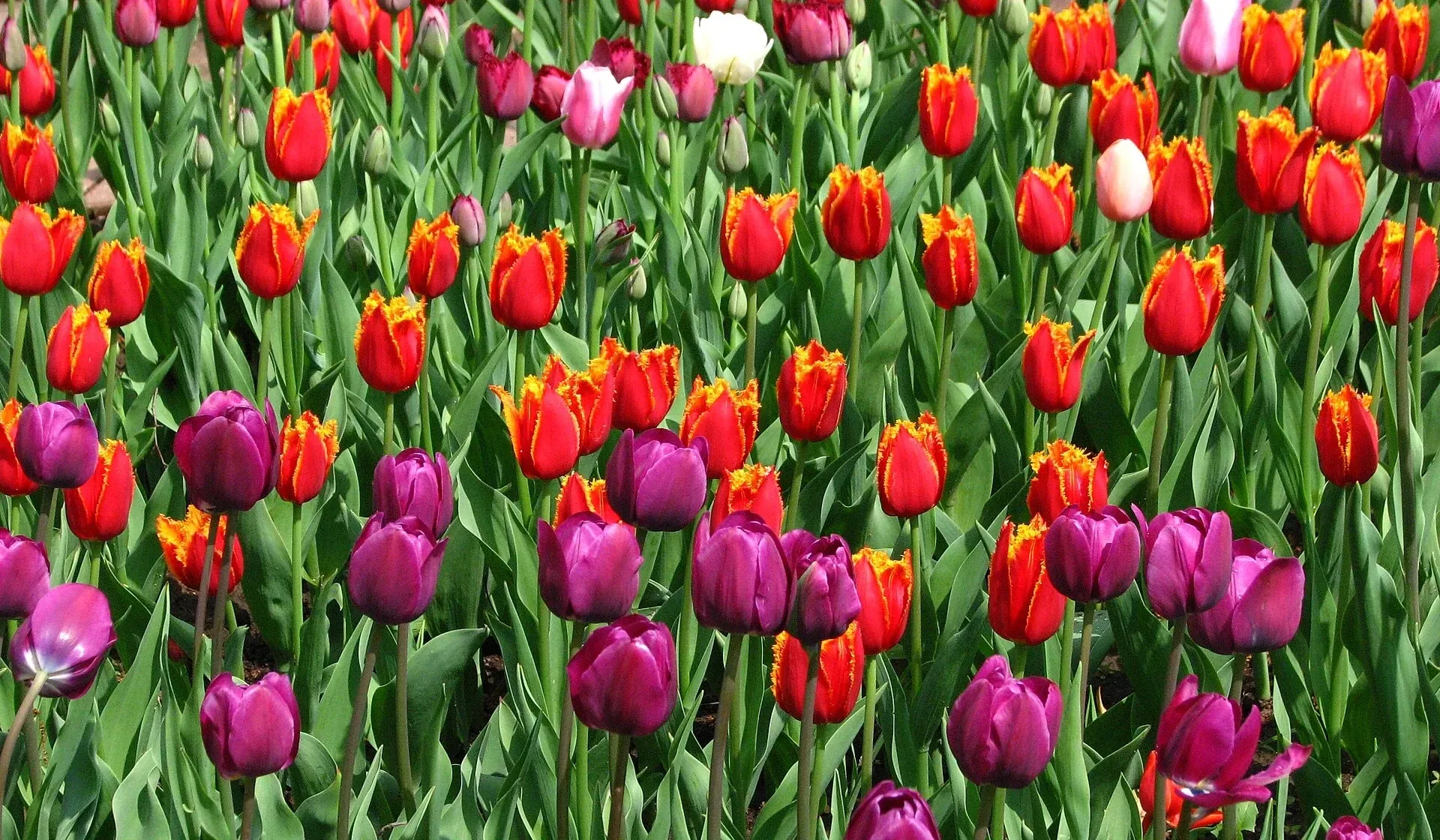
Longmeadow has been growing since the planting began in earnest in spring 1993. With Garden Design App, you add a photo of your garden, choose the Cottage style with Deep & rich colours, and ask for the jewel garden touches you love: dark tulips over red wallflowers, red dahlias with lime green euphorbia, low box round the bed. In just one minute you see your garden redesigned in rich jewel colours inspired by Longmeadow’s Jewel Garden, with your house, trees and fences kept.
- See the look before you spend. It is hard to picture ruby dahlias and dark tulips against your own fences. Try ruby and orange by the patio, then more sapphire and amethyst, and keep the design you love.
- Plants that will grow for you. With Pro or Max, every plant is named and picked to thrive where you live, in your light and soil, ready to buy, with a flowering calendar that shows the jewels coming in from tulips to dahlias.
- Save over £1,900. The average UK garden design costs £1,950, and a designer can take weeks to months to come back with a first design. Garden Design App gives you one in just one minute.
Your first 3 designs are free, with no card needed.
See a real Cottage garden redesignWhat is the Jewel Garden at Longmeadow, and who made it?
Monty Don’s Longmeadow is the garden he and his wife Sarah have made around their house in Herefordshire. When they bought it in October 1991, Monty writes, it was a two acre abandoned field at the back and builder’s rubble at the front, with one hazel tree and otherwise rough grass, nettles and brambles. The wind came from three sides, so he began with woven chestnut fences to shelter young hedges, and the planting began in earnest in spring 1993. Monty’s garden pages · Ideal Home
Today Monty Don’s garden contains several separate areas, which Homes & Gardens likens to huge garden rooms: among them a Cottage Garden, a Paradise Garden, a Vegetable Garden, a Herb Garden, a Dry Garden and the Jewel Garden. Monty calls the Jewel Garden “the physical and spiritual centre of the entire garden”. Homes & Gardens · Monty’s garden pages
It was made to celebrate the jewellery business he and Sarah ran in the 1980s, so every colour in it is meant to be like jewellery or metal. Its tone, he says, is just like the 1980s: “brash, extravagant and high maintenance!” The rich Herefordshire loam makes the plants grow with great vigour, which deepens the effect. Monty’s garden pages · Ideal Home
The jewel garden Monty Don made follows a clear rhythm. Spring is the time of his most intense tulips. Once the risk of frost has passed, tender plants are added: dahlias, gingers, bananas, cannas, tithonias, zinnias and sunflowers. It hits its stride in August and September, when warm nights and falling light make plum, caramel, purple and ruby red glow. As autumn bites it is cut back, the tender plants are lifted, and it rests until quite late in spring. Monty’s garden pages
This is one of our famous gardens guides. For Monty’s own account, see the garden pages on his website.
Why the Jewel Garden works: six ideas to borrow
These are the ideas worth taking home when planning a jewel border of your own, and each of them works in an ordinary garden.
A story behind every colour
The Longmeadow garden’s jewel border has a reason for each colour: the jewellery it celebrates. BBC Gardeners’ World names Monty’s among the best jewel gardens, “a riot of vivid colours” in emerald green, sapphire blue, amethyst, gold and ruby red. A theme like this makes choosing plants easier: each one either belongs in the jewel box or it does not. Gardeners’ World
Sun and late light
Rich colours need sun and late light. Monty notes that his richest colours glow in late summer, as the light falls and the heat builds. Gardeners’ World advises a sunny, sheltered site with soil that holds moisture, and says most jewel gardens are drifts of planting in a large south facing border. Put yours where the evening sun lands. Monty’s garden pages · Gardeners’ World
Green sets the jewels
Emerald is part of the palette, not a gap in it. Gardeners’ World calls Euphorbia characias subsp. wulfenii “a lovely foil for more colourful blooms”. Leaves between the flowers stop strong colours turning into a jumble, the way a setting holds a stone. Gardeners’ World
A seasonal relay
Gardeners’ World stresses keeping something in flower all the time, from alliums in spring to dahlias in autumn. Longmeadow does it by using the same ground twice: tulips first, then tender plants after the frosts. Tulips and dahlias are the two ends of the jewel year. Gardeners’ World · Monty’s garden pages
Generous, with less work
Be generous, and choose how much work you want. Monty is open that his version is high maintenance, with tender plants planted out and lifted every year. The idea works with less: our look leans on shrubs, perennials and bulbs that stay put, with a few dahlias and cannas as the stars. If the red and orange end is what you love, our hot colour border ideas page goes further.
Keep the jewels coming
A jewel border earns its place by flowering for months. Gardeners’ World says that if you carefully plan what you will grow and where, the display lasts for months on end. To keep plants blooming, it advises deadheading spent flowers and feeding with a high potash fertiliser once a fortnight. Gardeners’ World
The jewel garden plants through the year
First, the plants Monty’s own pages name at Longmeadow: the tulips and the tender summer plants. Then the plants in our Jewel Garden look, season by season.
Plants named in the Jewel Garden
- Intense tulips
- In spring the Jewel Garden is the home of Monty’s most intense tulips. Monty’s garden pages
- Dahlias, cannas, bananas and gingers
- Tender plants grown on and added once the risk of frost has passed, then lifted as autumn begins to bite. Monty’s garden pages
- Tithonias, zinnias and sunflowers
- More of the tender summer plants on Monty’s list. Monty’s garden pages
For August and September, when the Jewel Garden hits its stride, Monty also names helianthus, nicotiana and cosmos flowering exuberantly with the dahlias, bananas, zinnias, tithonia and sunflowers. Monty’s garden pages
Plants for a jewel garden at home
The named varieties below are not a list of what grows at Longmeadow. They are the plants in our Jewel Garden look: jewel tone flowers and leaves for an ordinary British garden, with easier stand ins for some tender plants. Two ideas come from another garden, Philippa Burrough’s Ulting Wick in Essex: big canna leaves, and clipped box edges that, in Gardenista’s words, “coolly contain an eruption of the hot and fiery”. Gardenista
| Season | What to plant |
|---|---|
| Spring | Gold and sapphire, then ruby, orange and emerald Gold winter aconites (Eranthis hyemalis) and the royal blue Iris ‘Harmony’ open the year, then sapphire Scilla forbesii and grape hyacinths (Muscari armeniacum). Then the tulips, the heart of spring at Longmeadow: in our look, the near black Tulipa ‘Queen of Night’ beside the orange, purple flamed ‘Prinses Irene’, over deep red wallflowers (Erysimum ‘Red Jep’) and the lime green euphorbia. Gardeners’ World suggests pairing a dark tulip with other dark ones or with orange, and this does both. Late spring brings the scarlet crown imperial (Fritillaria imperialis ‘Rubra’) and the ruby peony Paeonia lactiflora ‘Karl Rosenfield’. |
| Summer | Ruby and amethyst Violet Allium ‘Globemaster’ carries spring into summer. Then the ruby roses, the scented Rosa rugosa ‘Roseraie de l’Haÿ’ and the dark crimson climber Rosa ‘Guinée’, with purple Clematis ‘Polish Spirit’. From July the scarlet Dahlia ‘Bishop of Llandaff’ stands over dark bronze leaves (a Gardeners’ World pick for a jewel garden), with the red sprays of Crocosmia ‘Lucifer’ and the striped leaves of Canna Tropicanna. Verbena bonariensis and Stipa tenuissima thread through, and orange Calendula officinalis ‘Indian Prince’ fills the gaps. |
| Autumn | Amethyst and ruby The Jewel Garden at Longmeadow peaks in August and September, and our look carries that peak on into autumn: the burnt orange Dahlia ‘David Howard’, deep purple Salvia ‘Amistad’ and amethyst monkshood (Aconitum carmichaelii ‘Arendsii’). Into November, the crimson Camellia sasanqua ‘Crimson King’ and the strawberry tree (Arbutus unedo), with ruby fruit and flowers together, keep the colour going. |
| Winter | Emerald, gold and ruby Here our look parts company with Longmeadow, where the Jewel Garden is cut back and rests. Ours keeps a frame: low box edging (Buxus sempervirens ‘Suffruticosa’), green and gold Euonymus fortunei ‘Emerald ’n’ Gold’, Mahonia × media ‘Winter Sun’ and ruby witch hazel (Hamamelis × intermedia ‘Diane’). For more, see our guide to winter interest plants. |
How to get the jewel garden look in an ordinary garden
The Jewel Garden’s habits scale down to a normal plot. Start with one bed you can see from the house, and try the palette and a few plants for each season there before buying for the rest of the garden.
What to do first
Pick your sunniest, most sheltered bed, ideally the one you see most from the house. Monty’s Jewel Garden sits at the centre of his garden; yours belongs where you look. Settle the palette (ruby, sapphire, amethyst and gold, with green as the setting) and note one thing to flower in each season before you buy anything.
In a small garden
Gardeners’ World points out that you can make a container jewel garden by planting in pots and standing them close together. Dark tulips for spring and a dahlia or canna for late summer give you Longmeadow’s relay on a patio. Repeat a few colours rather than one of everything. Gardeners’ World
In part shade
Gardeners’ World advises a sunny site for a jewel garden, so give whatever sun you have to the flowers, in a bed or in pots. Elsewhere let leaves bring the colour: in our look, Bergenia ‘Overture’, whose leaves turn ruby in winter, and the purple leaved Heuchera ‘Forever Purple’. Check each label for the light it needs.
On a tight budget
Start with seeds and bulbs. Gardeners’ World says Calendula ‘Indian Prince’ is easy to grow from seed and good for filling gaps, and a bag of dark tulips gives the spring jewels. Spend on a few lasting plants, such as the euphorbia, and add the rest over time. At Longmeadow the tender plants are lifted each autumn, so a few good dahlias can be kept rather than bought again. Our cottage garden design guide covers the wider style.
Garden Design App
How can we help you transform your garden to look like Longmeadow’s Jewel Garden?
Planning a jewel border is hard to do in your head. It is a bold change, and easy to get wrong at the garden centre: it is hard to know whether ruby and orange will suit your brick and fences, and a bed that blazes with tulips in May can have little left to say by August. Mistakes cost money, and a whole season to find out. Garden Design App takes the guesswork away. It redesigns your own garden in a rich, jewel coloured cottage look, one border or the whole garden, so you see the result before you buy a single bulb. Our designs are inspired by Monty Don’s Jewel Garden and are not connected with Monty Don, Longmeadow or the BBC.
Think of a warm evening at the end of August: the light falling across the bed, scarlet dahlias standing over dark bronze leaves, red sprays of crocosmia with purple verbena threading between them, and lime green and emerald leaves holding each colour the way a setting holds a stone. It is the moment Monty describes at Longmeadow, when warm nights and falling light make plum, purple and ruby red glow richly. Earlier in the year the same ground was full of near black and orange tulips over deep red wallflowers, and in high summer the scent of a ruby rugosa rose met you on the path. In winter, low clipped box and gold and green leaves keep its shape. Ask for exactly that, and the app draws it into your garden, around the house, trees and fences you already have.
What you can ask for
Type any of these into the “Anything else?” box, in your own words:
- Near black and orange tulips over deep red wallflowers, for spring
- Scarlet dahlias on dark leaves, with red crocosmia and purple verbena, for late summer
- Sapphire and gold at the front: little blue irises, scillas and winter aconites
- Lime green euphorbia between the reds, so the strong colours have a green setting
- Low clipped box round the bed, to hold the hot colours in
- A dark crimson rose over an arch, or pots of tulips and a canna close together on the patio
How to design a jewel garden in five steps
- Start a free garden design. Press “Start my free garden design” and add a photo of the part of the garden you want to transform, ideally your sunniest bed. Your house, trees and fences stay where they are.
- Choose Cottage for the style and Sunny (6+ hrs) for the light, then pick Deep & rich for the colours, the nearest of the app’s colour choices to the ruby, plum and near black of the jewel palette. You add the sapphire and gold in your own words at the next step. If the red and orange end is what you love, pick Hot & bright instead.
-
Ask for the jewel garden touches you love in the “Anything else?” box.
“Rich jewel colours: ruby, sapphire, amethyst and gold, with dark tulips and red dahlias. Put lime green euphorbia between them and low clipped box round the bed.”
- See your garden transformed in just one minute. Look at the ruby and orange against the house, trees and fences the app keeps, and judge which bed should be the jewel box and how much colour your space can carry. Try a second design with more sapphire and amethyst, compare, and keep the one you love.
- Turn it into a garden you can plant. With Pro or Max (£29 or £49, paid once), every plant in your jewel garden design is named, picked for your light and soil and ready to buy, with the pot size and how tall it grows. A care guide and flowering calendar keep the relay going, from the first tulips to the last dahlias.
Why try it with Garden Design App first?
No guesswork
You don’t need to know the name of a single plant. You see the ruby and orange against your own fence, lawn and patio before you spend anything on it, and if the reds fight with your brickwork, you try more sapphire and amethyst instead.
Plants that will thrive
Pro and Max pick every plant to thrive where you live, in your light and soil, and name each one ready to buy. That matters in a jewel border, where every plant has to earn its place in the run from tulips to dahlias, and measured borders also tell you how many of each to buy.
Your garden stays familiar
Your house, trees and fences stay where they are, so the design fits the garden you already have, whether that’s one border or the whole plot.
A design in just one minute
A garden designer can take weeks to months to come back with a first design, and the average UK garden design costs £1,950. Save over £1,900, and start today with 3 free designs.
A real garden, before and after
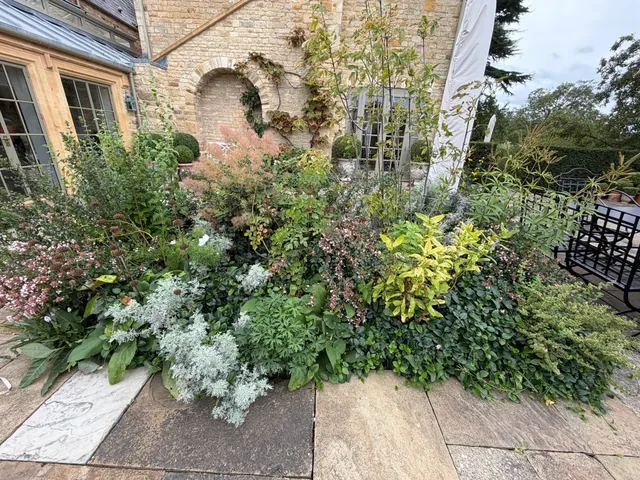 Original garden
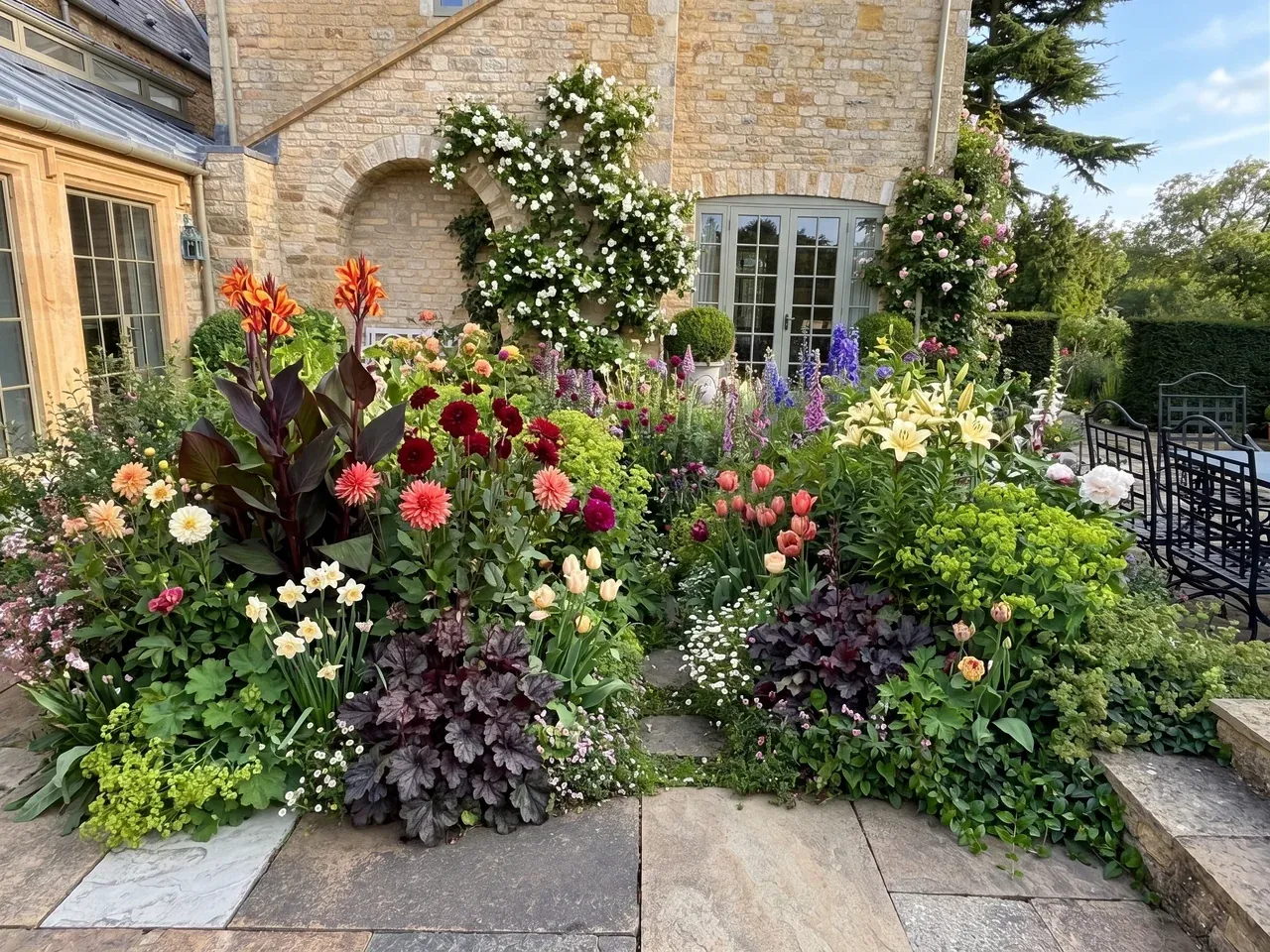 Cottage design
Over 500 garden designs made.
Try a layout before you spend on plants or a designer
A jewel border is a bold change, and easy to get wrong at the garden centre. Seeing it on your own garden first lets you judge which bed should be the jewel box, whether ruby and orange suit your brick and fences, and how much colour your space can carry, before you buy a single bulb. If the colour feels too much beside the house, or the box edging takes too much of a small bed, try a second layout while it’s still easy to change. Once you’ve found a layout you like, the planting list with Pro or Max tells you what to buy, so the look you chose becomes a border you can plant and you go to the garden centre with a plan. A garden designer can visit, measure and oversee the build. When you want that help, bring the look you found here.
Start with 3 free designs
Your first 3 designs are free, with no card needed, so you can try the jewel garden look three times before you spend anything: dark tulips and ruby dahlias, then more sapphire and amethyst, then the whole bed edged in box. For more ideas, our cottage garden design page shows real gardens redesigned in the Cottage style, our cottage garden ideas page shows cottage gardens redesigned in every colour, our design my garden page shows how it works, and our famous gardens guide has more great gardens to borrow from.
What you get with Garden Design App
Start free. When you’re ready for a plan you can plant from, choose Pro or Max. One payment, no subscription.
- Free £0
- Your first 3 designs
- Lower quality images with a watermark
- Pro £29
- 20 designs over 14 days
- 5 free designs on top
- 2 designs at once, side by side
- Max £49
- 50 designs over 30 days
- 10 free designs on top
- 4 designs at once, side by side
Turn the design you love into a garden you can plant
Every Pro or Max design comes with a Garden Transformation Pack: the plants, layout, materials and features, with a full care guide.
- Know what to buy. Get plants picked to thrive where you live, in your light and soil. Every plant is named, with the pot size to buy and how tall it grows. For a measured border, you also get how many of each plant to buy.
- Plan the whole garden. Get a layout and the features in your design, plus materials from gravel to fencing with whole garden designs.
- Know what to do through the year. Use the care guide to look after your plants and the flowering calendar to see what comes into bloom next.
- See the detail and ask for changes. Get higher quality images without a watermark, and change any design in your own words.
Your first 3 designs are free, with no card needed.
Questions about Longmeadow and the Jewel Garden
What is the Monty Don jewel garden?
It is the central part of Longmeadow, Monty Don’s garden in Herefordshire, made with Sarah to celebrate their 1980s jewellery business. Its colours are rich and jewel like: intense tulips in spring, then dahlias, cannas and other tender plants at their best in August and September. Monty’s garden pages
How can I make my garden look like Longmeadow’s Jewel Garden?
Give it the three things the Jewel Garden is built on: a sunny spot, rich jewel colours set against green leaves, and something in flower from tulip time to dahlia time. To try the look before you buy plants, add a photo of your garden to Garden Design App, choose Cottage with Deep & rich, and ask for dark tulips, red dahlias and lime green euphorbia in your own words. Your garden is redesigned in just one minute, and your first 3 designs are free.
Where is the Monty Don garden?
Longmeadow is in Herefordshire, around the house Monty and Sarah Don bought in October 1991, when the land behind it was an abandoned field. Monty’s garden pages · Homes & Gardens
Is it Longmeadow or Long Meadow?
Longmeadow, written as one word, is the spelling Monty uses on his own website. Monty’s garden pages
Is planting tulips and dahlias together a good idea?
In a jewel border they share the ground in turn rather than flowering at once. At Longmeadow intense tulips fill the Jewel Garden in spring, and tender plants such as dahlias go in once the risk of frost has passed. Gardeners’ World’s advice is to keep something in flower all the time, and dahlias and tulips sit at the two ends of that run. Monty’s garden pages · Gardeners’ World
What are the best jewel garden plants?
Gardeners’ World’s picks include Dahlia ‘Bishop of Llandaff’, the burgundy tulip ‘National Velvet’, the old rose ‘Charles de Mills’, Crocosmia ‘Lucifer’, zinnias, Calendula ‘Indian Prince’ and euphorbia as a green foil. Our look uses several of these, with close stand ins for others, such as ‘Queen of Night’ for the dark tulip. Our season by season table lists the plants in our look. Gardeners’ World
Can you make a jewel garden in a small space?
Yes. Gardeners’ World says you can make a container jewel garden by planting in pots and standing them close together. Dark tulips for spring and a dahlia or canna for late summer carry the relay, and a few repeated colours go further than one of everything. To check it fits before you plant, try it in Garden Design App with Cottage and Deep & rich; your first 3 designs are free. Gardeners’ World