

How we can help
How can you transform your garden to look like Glebe Cottage?
Carol has been shaping Glebe Cottage for almost five decades. With Garden Design App, you add a photo of your garden, choose the Cottage style with Shady (under 3 hrs) for the light, and ask for the Glebe Cottage touches you love, such as “hellebores, ferns and foxgloves under the tree, in crimson, plum and white”. In just one minute you see your garden redesigned as a packed, jewel coloured cottage bed in shade, with your house, trees and fences kept.
- See the look before you spend. A packed, many coloured border in shade is hard to picture before you spend anything on plants. Try crimson and white under the tree, then magenta and blue, and keep the design you love.
- Plants that will grow for you. With Pro or Max, every plant is named and picked to thrive where you live, in your light and soil, ready to buy, so the hellebores and ferns you bring home suit the shade they are going into.
- Save over £1,900. The average UK garden design costs £1,950, and a designer can take weeks to months to come back with a first design. Garden Design App gives you one in just one minute.
Your first 3 designs are free, with no card needed.
See a real Cottage garden redesignGlebe Cottage: the Carol Klein garden in North Devon
Carol Klein was born in Walkden, Lancashire, in 1945, and trained as a fine artist before plants became her living. After 13 years in London she moved to North Devon and set up a plant nursery at Glebe Cottage, in the village of Chittlehamholt near Umberleigh. She went on to win six gold medals at the Chelsea Flower Show, first appeared on Gardeners’ World in 1989 and has been one of its permanent presenters since 2005. The RHS gave her its Victoria Medal of Honour in 2018. Wikipedia · Gardeners Unearthed
The garden became television. Life in a Cottage Garden with Carol Klein, made for BBC Two and first shown in January 2011, followed a year at Glebe Cottage season by season, with her husband Neil and daughters Annie and Alice part of the story. Her Channel 5 series Gardening with Carol Klein was filmed there as well. The nursery closed in 2011 after a dispute with a neighbour; the garden carried on. Wikipedia · Gardeners Unearthed · Gardeningetc
What makes the Carol Klein garden famous is how much is in it. Visiting in summer, BBC Gardeners’ World Magazine found every corner packed with plants, in a garden she has been shaping for almost five decades. Gardeningetc describes a series of terraces at different levels, with box hedges cloud pruned in the Japanese way so they billow along the curves of the garden. Nearly every plant there was grown from seed by Carol herself, and flowers and vegetables share the beds on the slope. Gardeners’ World · Gardeningetc
Two terraces carry family stories. Alice’s garden is planted in what Carol calls “lots of white, lots of pink, crimson”; Annie’s, just beyond it, is more dramatic, in magenta, purples and blues, filled with roses. Gardeners’ World
Our sources describe the terraces, colours and crops rather than one shady border, so the shade in this guide is our own step: our Glebe Cottage look carries that crammed, jewel coloured planting under trees, where a great many ordinary gardens sit. This is one of our famous gardens guides, with more gardens like this to borrow from.
Why Glebe Cottage works: four ideas to borrow
These are the ideas worth taking home from a Carol Klein cottage garden, and each of them works in the shady side of an ordinary garden.
Fill every corner
What gives a Carol Klein cottage garden its feel is abundance: plants touching, little bare soil, something always coming next. Gardeners’ World found every corner of Glebe Cottage packed with plants. In shade that means layers: a carpet of low leaves, a middle of flowers and a few tall spires. Gardeners’ World
Tell a colour story
Give each area its own colour story. The daughters’ terraces show how three or four colours hold a busy border together. Our shady cottage garden borrows from both: crimson, plum black, magenta, raspberry and dusky pink, lit by white and touches of apricot, over fern green and purple leaves. Gardeners’ World
Evergreens hold the plenty
Let evergreen shapes hold the plenty. The cloud pruned box at Glebe Cottage gives a loose, crowded garden something solid to rest against. In our look, box, holly and evergreen ferns do the same job, so the bed still has a shape in January. Gardeningetc
Let the seasons take turns
Life in a Cottage Garden followed the garden through a whole year, one season at a time. Plan a bed the same way, so that as one group of plants fades the next is already coming through. Gardeners Unearthed
The plants through the year in our Glebe Cottage look
First, the plants that published accounts name at Glebe Cottage. Then the plants in our shady Glebe Cottage look, season by season, and the evergreens that hold it together.
Plants named at Glebe Cottage in published accounts
- Cloud pruned box
- Box hedges inspired by the Japanese technique of cloud pruning, billowing along the natural curves of the garden. Gardeningetc
- Roses
- Annie’s terrace, in magenta, purples and blues, is filled with roses. Gardeners’ World
- Sweet peas and runner beans
- They scramble up supports, and Carol cuts the sweet peas to bring into the house. Gardeners’ World
- Vegetables among the flowers
- Her main vegetable area is packed with parsley, peas and tomatoes alongside flowers, squashes and sweetcorn. Gardeners’ World
Gardeningetc adds that nearly every plant at Glebe Cottage has been grown from seed by Carol, which makes her greenhouse essential to the garden, and that the vegetable patch on the slope is a sun trap. None of these accounts describes a shady border, so the shade planting below is ours. Gardeningetc
Plants for a shady cottage garden at home
These are the plants in our Carol Klein’s Glebe Cottage theme, chosen by us for dappled and part shade. Apart from the cloud pruned box, they are our choices for the look, not a list of what grows at Glebe Cottage. Our Glebe Cottage theme
| Season | What to plant |
|---|---|
| Spring | A jewelled carpet under bare branches Spring opens with snowdrops (Galanthus elwesii) and winter aconites (Eranthis hyemalis) between Harvington hellebores (Helleborus × hybridus), including the near black ‘Harvington Black’. Then come native bluebells (Hyacinthoides non-scripta), shuttlecock ferns (Matteuccia struthiopteris) unfurling with them, violet bishop’s hat (Epimedium grandiflorum ‘Lilafee’) for dry shade under trees, bleeding heart (Lamprocapnos spectabilis), maroon and white columbines (Aquilegia vulgaris ‘William Guiness’) and the dusky cranesbill (Geranium phaeum ‘Samobor’). |
| Summer | Spires in crimson, pink and white Summer is the season of shade loving flowering plants. Foxgloves (Digitalis purpurea) seed themselves along the edge, ruby masterwort (Astrantia major ‘Claret’) gives crimson pin cushions, Turk’s cap lilies (Lilium martagon) settle into dappled shade and the climbing rose ‘New Dawn’ takes the wall. For tall plants for shade, goat’s beard (Aruncus dioicus) and lilac meadow rue (Thalictrum delavayi ‘Hewitt’s Double’) rise behind. |
| Autumn | Late flowers under copper leaves Autumn brings Japanese anemones (Anemone × hybrida ‘Königin Charlotte’), amethyst monkshood (Aconitum carmichaelii ‘Arendsii’), dark leaved bugbane (Actaea simplex ‘Brunette’) and lilac blue asters (Symphyotrichum ‘Little Carlow’), while beech (Fagus sylvatica) turns copper overhead. |
| Winter | Scent and evergreen shape Winter belongs to the Christmas rose (Helleborus niger), double snowdrops and scent: Viburnum × bodnantense ‘Dawn’, a winter daphne (Daphne bholua ‘Jacqueline Postill’) and sweet box (Sarcococca hookeriana) by the path, with holly, box and evergreen ferns keeping the bed’s shape. Our winter interest plants page goes further on that season. |
Evergreen plants for shade that hold the look together
Flowers come and go; the evergreens make these year round plants for shaded areas. In our look they are box (Buxus sempervirens) for cloud pruning, as Carol does at Glebe Cottage, a berrying holly (Ilex aquifolium ‘J.C. van Tol’), Mahonia × media ‘Charity’ with yellow winter spires, and on the floor the soft shield fern (Polystichum setiferum), hart’s tongue fern (Asplenium scolopendrium) and Corsican hellebore (Helleborus argutifolius).
Partial shade shrubs give the layer between floor and trees: the white lacecaps of Viburnum plicatum f. tomentosum ‘Mariesii’, the white mopheads of Hydrangea arborescens ‘Annabelle’ and the hardy Fuchsia ‘Mrs Popple’. This is woodland edge planting: shrubs at the back, flowers in front, light from one side.
How to plant a shady cottage garden inspired by Glebe Cottage
The habits of a Carol Klein cottage garden scale down to a normal plot, and they suit the shady side of it. Start with one bed you can see from the house or walk past often, and try the bones and a few flowers there before buying for the rest of the garden.
Watch the shade first
Start by watching where the shade falls through a day. The best plants for shade in this look are chosen for dappled light under trees or beside a fence, not deep, dry darkness, so begin in the corner that gets some morning or evening sun.
Plant the bones first
One evergreen shrub, a few ferns and three hellebores give a shady corner its shape. Then add flowers in layers, low at the front and tall at the back, and keep to the colour story so the crowd still looks planned.
Use one bed in a small garden
In a small garden, take one bed rather than the whole plot: a strip along a shady fence with a climbing rose, foxgloves behind and hellebores and ferns in front. Repeat the same few plants rather than one of everything. Where one end gets more sun, use the part shade plants from the theme there, such as the scented magenta phlox (Phlox paniculata ‘Düsterlohe’).
Let seed do the work
On a tight budget, follow Carol’s lead and let seed do the work. In our look the foxgloves and columbines are there partly because they seed about. Spend on the evergreens and hellebores, which stay, and let the self seeders fill the gaps. Our shade garden design page covers shade more widely, and cottage garden design shows the style in sun.
Garden Design App
How can we help you transform your garden to look like Glebe Cottage?
Planning a shady cottage garden is hard to do in your head. A shady corner is often the part of a garden people give up on, and it is easy to get wrong at the garden centre: one of everything looks muddled rather than packed, plants bought for sun struggle under the tree, and a bed that is full of hellebores in March can have little left to say by July. Mistakes cost money, and a whole season to find out. Garden Design App takes the guesswork away. It redesigns your own garden in a crowded, jewel coloured cottage look for shade, one border or the whole garden, so you see the result before you buy a single plant. The look is inspired by Glebe Cottage; it is our own design, not Carol Klein’s, and it is not connected with Carol Klein, Glebe Cottage, the BBC or Channel 5.
Think of a spring morning under your own tree: shuttlecock ferns unfurling through a carpet of bluebells, near black and pink hellebores nodding at the front, and maroon and white columbines coming up wherever they seeded last year. By early summer foxgloves rise along the fence, ruby masterworts fill the middle and the pearl pink rose ‘New Dawn’ opens on the wall. In autumn pink Japanese anemones carry on under the copper of the beech, and on a January afternoon the scent of sweet box and daphne meets you on the path while box clipped into soft clouds keeps the bed’s shape. It is the packed plenty Gardeners’ World found at Glebe Cottage, carried into the shade. Ask for exactly that, and the app draws it into your garden, around the house, trees and fences you already have.
What you can ask for
Type any of these into the “Anything else?” box, in your own words:
- Hellebores, ferns and foxgloves under the tree, in crimson, plum and white
- Box clipped into soft clouds along the curve of the bed
- A climbing rose on the shady fence, with foxgloves behind and hellebores and ferns in front
- Bluebells and snowdrops under the shrubs, with shuttlecock ferns coming through
- Sweet box and a winter daphne by the path, for scent in January
- One end in white, pink and crimson like Alice’s terrace, the other in magenta, purple and blue like Annie’s
How to design a shady cottage garden in five steps
- Start a free garden design. Press “Start my free garden design” and add a photo of the part of the garden you want to transform: the bed under a tree, the strip along a shady fence or the corner that only gets morning sun. Your house, trees and fences stay where they are.
- Choose Cottage for the style and Shady (under 3 hrs) for the light, then pick Deep & rich for the colours, the nearest of the app’s colour choices to the crimson, plum black and magenta of this look. If the spot gets three to six hours of sun, pick Part sun (3–6 hrs) instead, and if Alice’s white, pink and crimson is more your taste, pick Pink-led. Cottage is the place to start because this look is packed and colourful, not calm and green like a woodland.
-
Ask for the Glebe Cottage touches you love in the “Anything else?” box.
“Pack the bed under the tree with hellebores, ferns and foxgloves in crimson, plum and white. Clip box into soft clouds along the curve, and put a climbing rose on the fence.”
- See your garden transformed in just one minute. Look at the crowd of plants against the house, trees and fences the app keeps, and judge how much of the shade the bed should fill. Try a second design in magenta, purple and blue, like Annie’s terrace, compare, and keep the one you love.
- Turn it into a garden you can plant. With Pro or Max (£29 or £49, paid once), every plant in your design is named and picked for your light and soil, so the hellebores, ferns and foxgloves you buy suit the shade they are going into. Each comes with the pot size to buy and how tall it grows, plus a care guide and a flowering calendar that shows the seasons taking turns, from snowdrops to Japanese anemones.
Why try it with Garden Design App first?
No guesswork
You don’t need to know the name of a single plant. You can look at a crowded, jewel coloured cottage bed under your own tree before you spend anything on it, and try crimson and white against magenta and blue until one feels right.
Plants that will thrive
Pro and Max pick every plant to thrive where you live, in your light and soil, and name each one ready to buy. That matters most in shade, where the light decides what will grow, and measured borders also tell you how many of each to buy.
Your garden stays familiar
Your house, trees and fences stay where they are, so the design fits the garden you already have, including the tree that makes the shade, whether that’s one border or the whole plot.
A design in just one minute
A garden designer can take weeks to months to come back with a first design, and the average UK garden design costs £1,950. Save over £1,900, and start today with 3 free designs.
A real garden, before and after
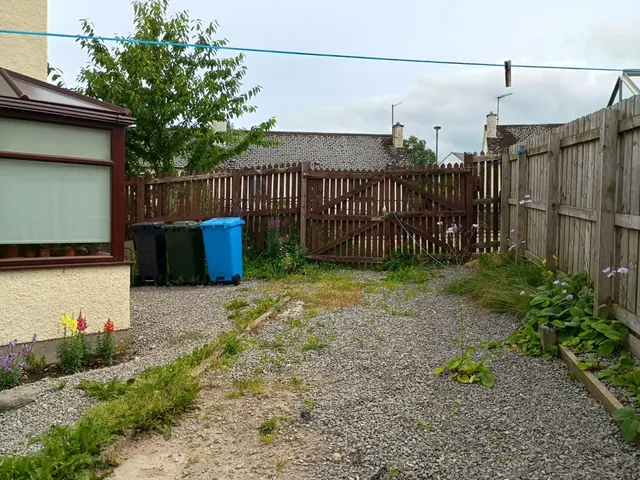 Original garden
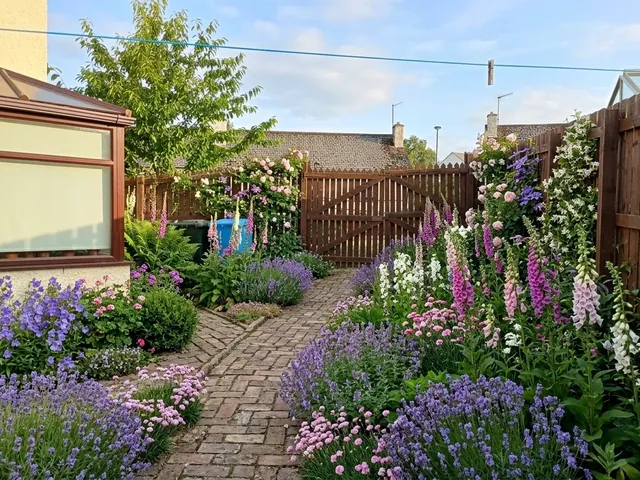 Cottage design
Over 500 garden designs made.
Try a layout before you spend on plants or a designer
A shady bed is often the one people put off, because it is hard to know what will grow there and how full it should be. Seeing it on your own garden first lets you judge how far the planting should run under the tree, whether crimson or white shows up best against your fence, and where the box clouds belong, before you buy a single plant. If the bed feels too crowded, or the climbing rose hides a window, try a second layout while it’s still easy to change. Once you’ve found a layout you like, Pro or Max turn it into a garden you can plant, with every plant named and ready to buy and a care guide to grow it well, so the look you chose is the garden you get and you go to the garden centre with a plan. A garden designer can visit, measure and oversee the build. When you want that help, bring the look you found here.
Start with 3 free designs
Your first 3 designs are free, with no card needed, so you can try the Glebe Cottage look three times before you spend anything: crimson, pink and white like Alice’s terrace, then magenta, purple and blue like Annie’s, then the same bed with box clipped into clouds. For more ideas, our cottage garden design page shows real gardens redesigned in the Cottage style, our shade garden design page covers planting for shade, our design my garden page shows how it works, and our famous gardens guide has more great gardens to borrow from.
What you get with Garden Design App
Start free. When you’re ready for a plan you can plant from, choose Pro or Max. One payment, no subscription.
- Free £0
- Your first 3 designs
- Lower quality images with a watermark
- Pro £29
- 20 designs over 14 days
- 5 free designs on top
- 2 designs at once, side by side
- Max £49
- 50 designs over 30 days
- 10 free designs on top
- 4 designs at once, side by side
Turn the design you love into a garden you can plant
Every Pro or Max design comes with a Garden Transformation Pack: the plants, layout, materials and features, with a full care guide.
- Know what to buy. Get plants picked to thrive where you live, in your light and soil. Every plant is named, with the pot size to buy and how tall it grows. For a measured border, you also get how many of each plant to buy.
- Plan the whole garden. Get a layout and the features in your design, plus materials from gravel to fencing with whole garden designs.
- Know what to do through the year. Use the care guide to look after your plants and the flowering calendar to see what comes into bloom next.
- See the detail and ask for changes. Get higher quality images without a watermark, and change any design in your own words.
Your first 3 designs are free, with no card needed.
Questions about Carol Klein’s garden
Where does Carol Klein live?
At Glebe Cottage in Chittlehamholt, near Umberleigh in North Devon, where she moved from London and set up her nursery. Gardeners’ World describes it as a garden she has been shaping for almost five decades. Wikipedia · Gardeners’ World
How can I make my garden look like Carol Klein’s garden at Glebe Cottage?
Give it the three things the look is built on: plants packed into every corner, a colour story of three or four colours, and evergreen shapes such as clipped box to hold the plenty. In shade, start with hellebores, ferns and an evergreen shrub, then foxgloves and masterworts. To try the look before you buy plants, add a photo of your garden to Garden Design App, choose Cottage with Shady (under 3 hrs) and Deep & rich, and ask for hellebores, ferns and foxgloves in your own words. Your garden is redesigned in just one minute, and your first 3 designs are free.
Why did Carol Klein close her nursery?
According to Wikipedia, she closed the nursery at her home in Chittlehamholt in 2011 after a dispute with her neighbour. The garden at Glebe Cottage carried on. Wikipedia
Where was Gardening with Carol Klein filmed?
At Glebe Cottage, her garden in Devon, according to Gardeningetc. Her BBC Two series Life in a Cottage Garden with Carol Klein, first shown in January 2011, was made there too and followed the garden through a year, season by season. Gardeningetc · Wikipedia · Gardeners Unearthed
What are the best plants for a shady cottage garden?
In our Glebe Cottage look: hellebores, snowdrops and bluebells in spring, foxgloves, masterworts and martagon lilies in summer, Japanese anemones and bugbane in autumn, and sweet box, daphne and evergreen ferns in winter, all for dappled or part shade. Our season by season table names each one.
What are good evergreen plants for shade?
In our look, box and holly give shape, Mahonia ‘Charity’ gives winter colour, and the soft shield fern, hart’s tongue fern and Corsican hellebore keep the floor green all year.
Can I get the Glebe Cottage look in a small garden?
Yes. Take one shady bed or the strip along a fence, plant the evergreens and hellebores first, keep to three or four colours and repeat them. To check it fits before you plant, add a photo of your garden to Garden Design App, choose the Cottage style and see it redesigned in just one minute before you buy anything; your first 3 designs are free.
About the author
Sources
- Wikipedia, Carol Klein
- BBC Gardeners’ World Magazine, A visit to Carol Klein’s garden
- Gardeningetc, Carol Klein’s garden
- Gardeners Unearthed, Life in a Cottage Garden with Carol Klein
- Garden Design App, Glebe Cottage Shady Side theme, our own shade theme inspired by Glebe Cottage
- Garden Design App homepage