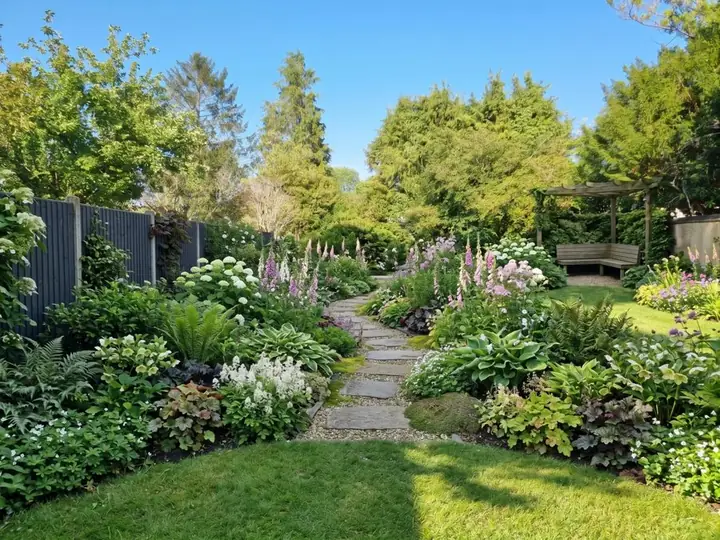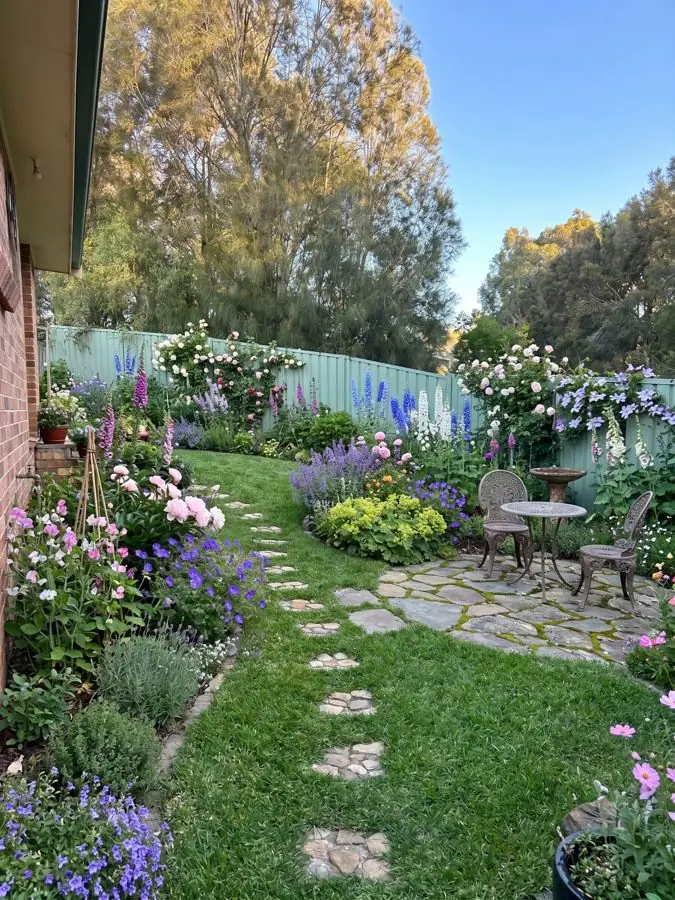
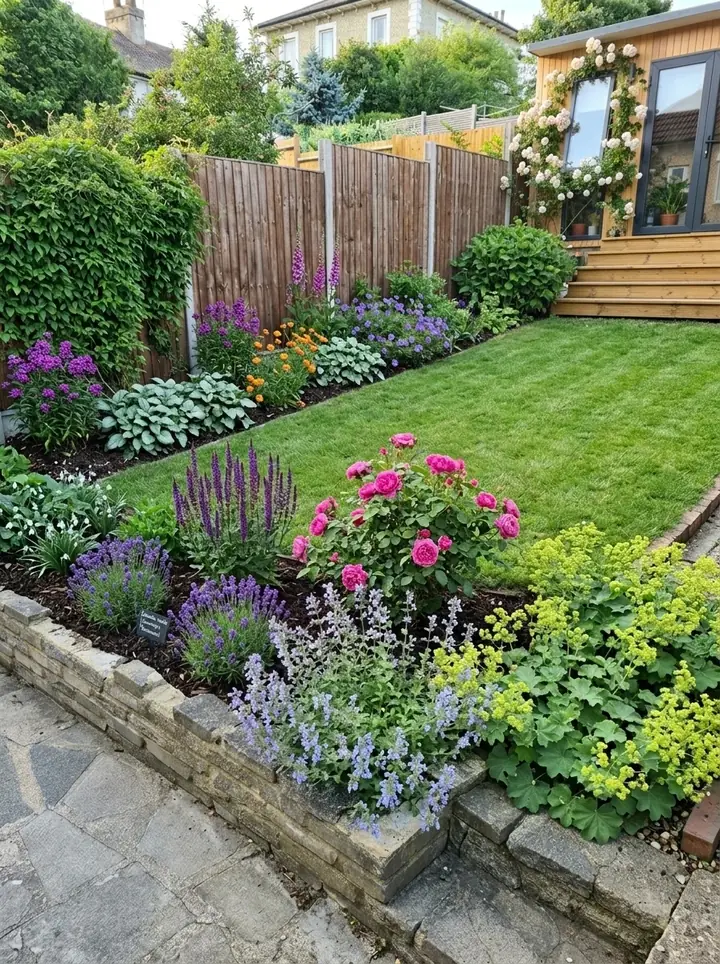
What plants go well together in a garden: the 7 rules at a glance
Good plant partners share two things: they grow well in the same conditions, and they look better side by side than apart. The rules below answer what plants and flowers go well together. They come from US extension services and the New York Botanical Garden (NYBG), and they apply to a flower bed or a border along a fence alike.
- Match light, soil and water needs.
- Layer heights: tall at the back, short in front.
- Contrast leaf shape and texture.
- Choose a color scheme.
- Plant in groups and repeat them.
- Line up bloom times through the seasons.
- Start from combinations that already work.
1. Match light, soil and water needs first
This is the rule that decides whether a combination grows well, not just whether it looks good. Colorado State University Extension calls it the most important consideration: group plants by their growing needs, and put plants with similar water needs together so you can water them the same way. Its example is drought tolerant plants together at the top of a slope and moisture loving plants in a low spot where runoff collects, which it calls hydrozoning.
Before you choose anything, the NYBG suggests checking three things about the spot:
- Light: full sun is 6 or more hours a day, partial sun 4 to 6 hours, partial shade 2 to 4 hours.
- Water: does the area stay wet in summer or in winter?
- Roots: is there heavy root competition from nearby trees?
Know your soil
Mississippi State University Extension notes that most garden perennials need at least half a day of sun and well drained soil, though many are suited to shady or wet places too. Both Colorado State and Mississippi State recommend a soil test before planting, so you know your soil's nutrients and acidity before you pick plants for it. Garden Design App does this matching for you: add your ZIP code and the plants in your design are picked for your USDA zone, your summer heat, your light and your soil.
2. Layer heights, tall at the back and short in front
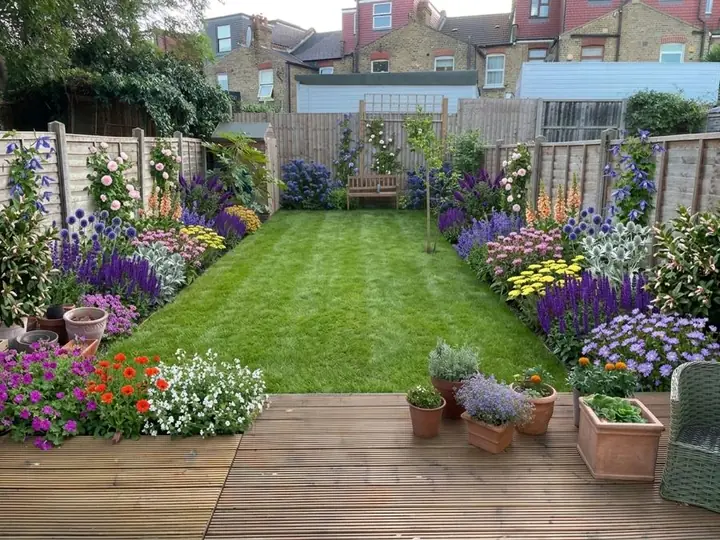
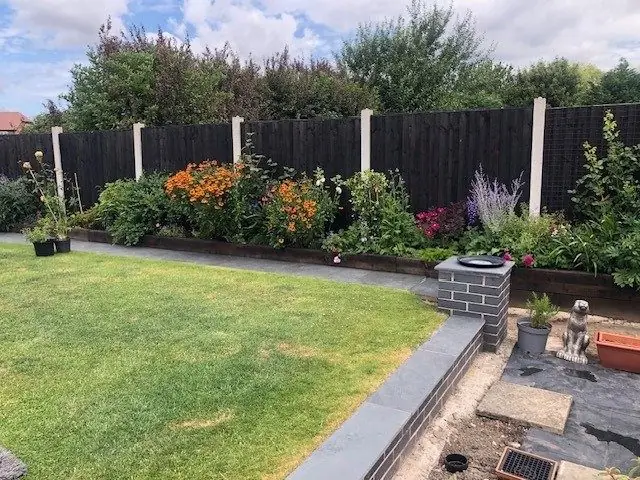
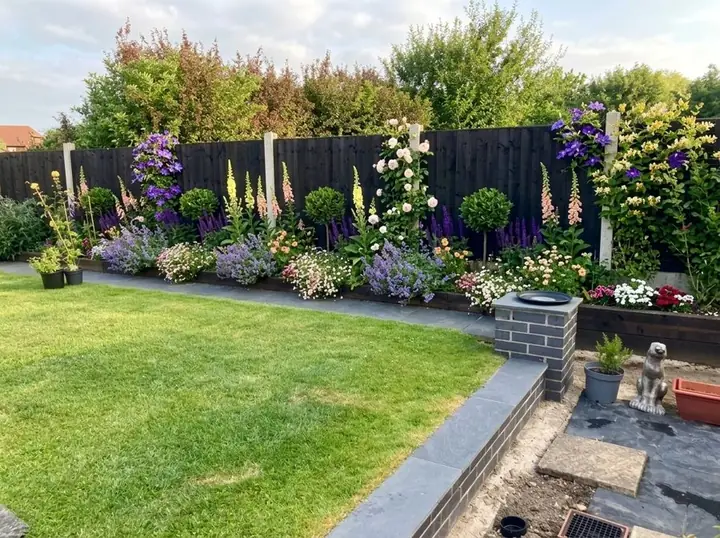
Colorado State's advice is simple: taller plants at the back of a bed, or in the middle of a bed you see from all sides, and shorter plants toward the front. Bring a few taller plants forward so the heights vary.
Check the label for the height of the exact variety you are buying. The NYBG points out that varieties of one plant can differ a lot: one perennial sunflower may grow 4 to 6 feet tall and another 6 to 10 feet.
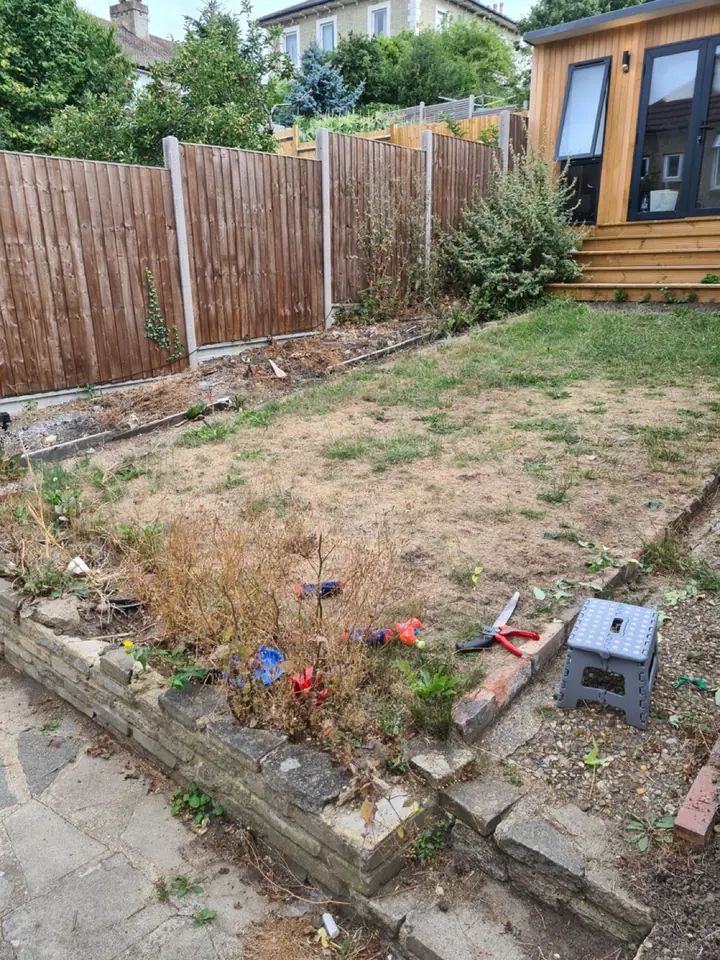
 Before
 After
3. Contrast leaf shape and texture
The NYBG says form and texture matter as much as color in a plant combination, because they hold it together once the flowers fade. Feathery leaves next to big, bold ones make plant pairings whose contrast shows off both plants.
Mississippi State Extension suggests silvery foliage such as dusty miller or Jerusalem sage, the strap shaped leaves of iris, the fine texture of grasses, and the variegated leaves of liriope or Aztec grass for accents. In a shady corner, the NYBG reminds us that green is a color too: mix shades from bright chartreuse to deep forest green.
4. Choose a color scheme
Once growing conditions match, color is one way to choose what flowers go well together in a garden, alongside the leaf texture in rule 3. The NYBG divides colors into cool (blues, purples and greens) and hot (reds, yellows and oranges). Colors from opposite sides of the color wheel make each other look stronger, and colors that sit next to each other on the wheel calm each other down.
Mississippi State Extension adds two practical points: look at the color of your house and surroundings when you choose flower colors, and plant evergreen shrubs behind your flowers, because bright or airy flowers show up better against a dark green background.
| Scheme | Colors | What the source says |
|---|---|---|
| Cool | Blues, purples and greens | A cool, soothing combination of blues and greens (Mississippi State) |
| Hot | Reds, yellows and oranges | NYBG calls these the hot colors |
| Contrasting | Colors opposite on the color wheel | Each color looks more intense (NYBG) |
| Harmonious | Colors next to each other on the wheel | Each color looks less intense (NYBG) |
5. Plant in groups and repeat them
Colorado State recommends planting the same variety in groups of three, five or seven for more impact, then repeating each group two or three times in the bed for a sense of flow. The NYBG agrees: repeating colors, shapes and textures is what makes a planting feel like one design, and planting in large drifts lets the details of each pairing show.
The NYBG also warns against buying one of every plant you fall for at the nursery. Fewer plants, not competing for space, make a stronger combination.
6. Line up bloom times through the seasons
Plants that flower one after another keep a bed in color for longer. Mississippi State Extension says spring and fall usually offer the widest choice of flowering plants, and adding summer bloomers keeps color going through the whole season. Colorado State suggests adding annuals and bulbs for extra splashes of color.
The NYBG's example: peonies and Siberian irises flower together from May into June. It also pairs peonies, whose new leaves come up red, with early bulbs such as Siberian squill or miniature daffodils.
Bloom times move with your weather, soil and altitude; Colorado State notes that plants flower later at higher elevations. Treat any calendar as a guide for your own yard, not a promise.
7. Start from combinations that already work
The NYBG's advice is to copy combinations that work in other gardens, then make them your own with different varieties. Its own example is daylilies with hydrangeas: try bigleaf or oakleaf hydrangeas with different daylilies. These are the classic plant and flower combinations the NYBG lists. It does not give light or water needs for each pair, so check every plant against rule 1 and your zone before you buy.
| Plants that go well together | Source |
|---|---|
| Peonies and Siberian irises | NYBG (flower together May into June) |
| Daylilies and hydrangeas | NYBG |
| Catmint and roses | NYBG |
| Coneflower and Russian sage | NYBG |
| Sea holly and Russian sage | NYBG |
| Salvia and hardy geraniums | NYBG |
| Salvia and yarrow | NYBG |
| Beebalm and ornamental grasses | NYBG |
| Asters and ornamental grasses | NYBG |
| Joe-pye weed and stonecrop | NYBG |
| Hot poker plant and Helen's flower | NYBG |
| Globe thistle, Helen's flower and garden phlox | NYBG |
| Mexican sunflower and cannas | NYBG |
| Astilbe and hosta | NYBG |
| Wild ginger and hellebores | NYBG |
| Wild bleeding heart, hosta and Solomon's seal | NYBG |
| Japanese hakone grass and lady's mantle | NYBG |
| Cornflower and fern-leaf dill | NYBG |
| Nasturtiums and Swiss chard | NYBG |
| Scented geraniums and herbs | NYBG |
 Before
 After
What to plant with roses, hydrangeas and hostas
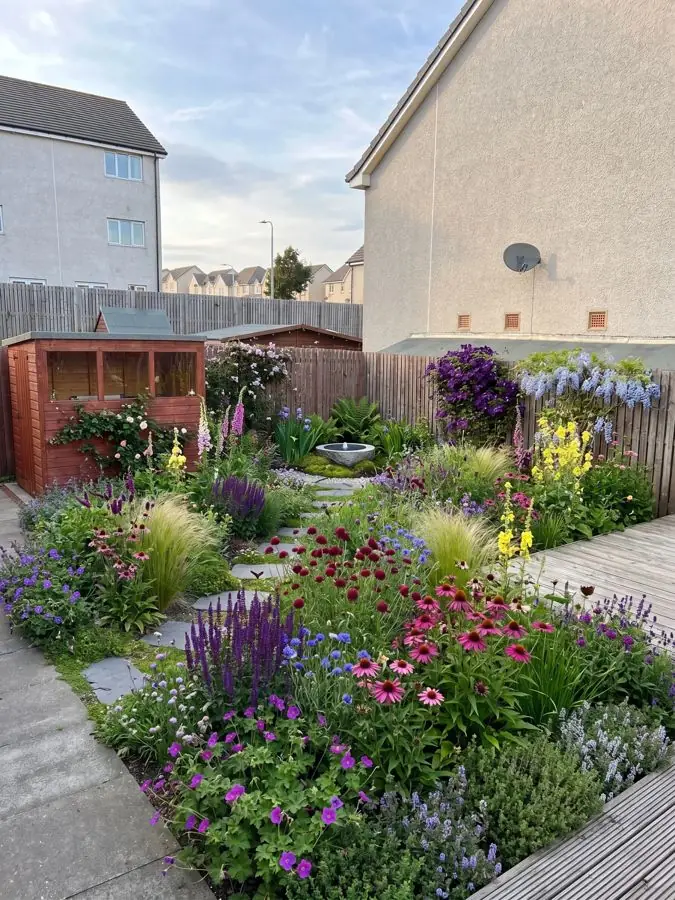
- What to plant with roses: catmint is the NYBG's classic partner, and a perennial border pictured in its guide mixes roses and catmint with salvia and hardy geraniums.
- What to plant with hydrangeas: daylilies. The NYBG suggests trying bigleaf or oakleaf hydrangeas with different daylilies.
- What to plant with hostas: astilbe, or wild bleeding heart with Solomon's seal. Both are on the NYBG's list of classic combinations.
Easier swaps for fussy plants
Choose partners you can look after. The NYBG notes that delphiniums can be a lot of work while monkshoods are easy, and that lupines are short lived while false indigo (Baptisia) lasts for years.
What about vegetables that grow well together?
In a vegetable garden, plants that go well together are called companion plants. UMass Extension describes growing corn, pole beans and winter squash together as a way to make the most of a small plot: the cornstalks act as a living trellis for the beans, and the low, large leaved squash shades the ground, helping the soil stay moist and suppressing weeds. It also notes that basil, cilantro, dill, fennel and parsley give shelter and food to insects that prey on garden pests.
UMass is honest about the limits. There are far fewer careful studies of companion planting than there are charts about it, and on marigold companion planting it reports that African and French marigold roots produce chemicals toxic to root nematodes (tiny soil organisms that can harm plants or reduce yields), with the benefit coming only after the marigolds are grown as a cover crop and dug into the soil. It finds very little other evidence for them. Its broader advice is to keep plenty of variety in the garden, which helps protect the health of the whole planting.
Plan it before you plant it
Mississippi State Extension recommends trying your design on paper first, because mistakes cost less to fix there. Draw the bed to scale and mark the trees, fences, structures, lawn, shrubs and walkways already in place, then fit your plant groups around them. It also warns against making a garden bigger than you can build and look after: perennial beds need regular watering, feeding, pruning, deadheading and weeding. Or try it on your own yard first: add a photo to Garden Design App and see it redesigned in about a minute, with plants picked for your zone, light and soil, so you know a combination works before you buy a single plant.
Why use Garden Design App?
You do not need to know plant names or draw to scale.
Your own yard, from one photo
One photo from your phone is all it takes. Your real yard, planted, in about a minute.
Ask for anything you want
Pick one of 15 styles and a color scheme, then ask for anything you want, like “add a fire pit” or “more shade”.
Keep what works
Keep your paths and patio, or start over with a new layout.
A designer’s structure
Height, color and balance arranged the way a professional would.
Plants for your zone
Your ZIP code gives us your USDA zone, so the plants we pick can live through your winters.
Nothing to download
This online landscape design runs in your browser with nothing to download.
Questions people ask
What flowers go well together with peonies?
The NYBG calls peonies and Siberian irises a classic combination, flowering together from May into June. It also pairs peonies, whose new leaves come up red, with early bulbs such as Siberian squill or miniature daffodils.
Should I plant in odd numbers?
Colorado State University Extension recommends groups of three, five or seven of the same variety for more impact, with each group repeated two or three times in the bed.
Can plants with different water needs go in the same bed?
It is better not to mix them. Colorado State recommends putting plants with similar water needs together so you can water each group the right amount, with drought tolerant plants on higher, drier ground and moisture lovers in low spots.
Does companion planting really work?
UMass Extension says careful studies are few compared with the number of charts, so treat any list as a starting point. Its firmer advice: keep plenty of variety in the garden, and grow herbs such as dill and parsley that give shelter and food to insects that prey on pests.
How do I make plants look good together if my yard is shady?
Choose plants that suit shade first. Then, as the NYBG suggests, lean on leaf color and texture, mixing shades of green from chartreuse to deep forest green. Garden Design App picks plants for your light, so a design for a shady yard comes back with plants that suit shade.
Sources (5)
- New York Botanical Garden (NYBG), Winning Plant Combinations, read November 14, 2026
- Colorado State University Extension, Perennial Gardening, read November 14, 2026
- Mississippi State University Extension, Creating the Perennial Garden, read November 14, 2026
- UMass Extension, Companion Planting in the Vegetable Garden, read November 14, 2026
- Garden Design App, US homepage, read November 13, 2026